Learn what every symbol on the card means.Full credits and sources at beakbrain.com/symbols
 ForestCup nestMedium · 106 g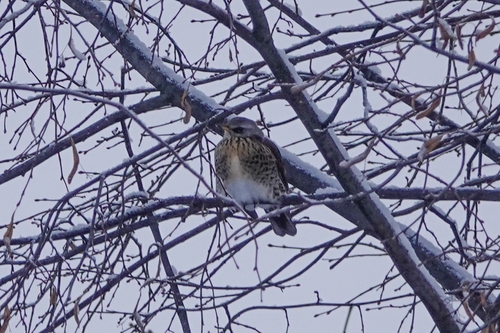
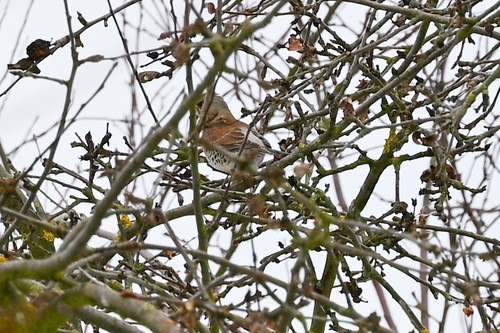


What the Fieldfare sounds like


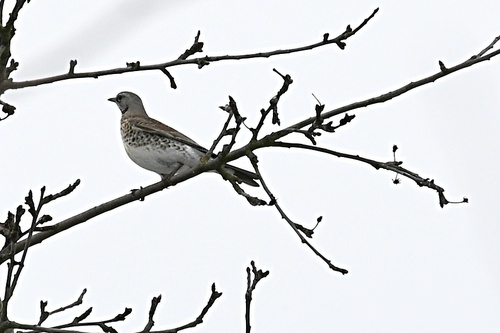
ID tip
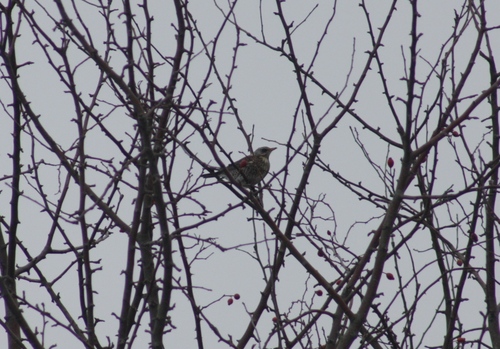
The fieldfare is easily recognisable with its slate-grey head, nape and rump, dark brown back, blackish tail and boldly speckled breast. In flight, its white under wing-coverts and axillaries are conspicuous. The harsh flight call "tsak tsak" is also distinctive. The forehead and crown of the male are bluish-grey and each feather has a central brownish-black band. The lores and under-eye regions are black and there are faint, pale streaks above the eyes. The ear-coverts, nape, hind neck and rump are bluish-grey, usually with a white streak near the shaft of each rump feather.
Text from Wikipedia, licensed CC BY-SA 4.0.
When to see the Fieldfare
One bar for each month. Filled bars are the 11 months with records; pale bars are months with none. The wide bar is June, the month with the most records.
Where to see the Fieldfare
The map shades 68 countries with regular records, and 6 more in a lighter tone where the bird turns up only as a stray. Everything unshaded has no records. Countries are listed below the map.
Recorded as a rare visitor in United States, India, Egypt, Tunisia, St. Pierre & Miquelon, Lebanon.
About the Fieldfare
The fieldfare is a member of the thrush family Turdidae. It breeds in woodland and scrub in northern Europe and across the Palearctic. It is strongly migratory, with many northern birds moving south during the winter. It is a very rare breeder in the British Isles, but winters in large numbers in the United Kingdom, Southern Europe, North Africa and the Middle East. It is omnivorous, eating a wide range of molluscs, insects and earthworms in the summer, and berries, grain and seeds in the winter.
Text adapted from Wikipedia, licensed CC BY-SA 4.0.
Easily confused with
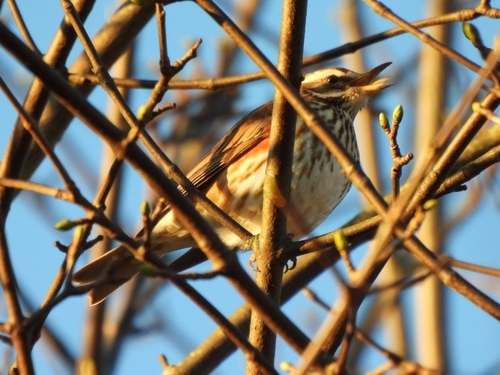 RedwingTurdus iliacusThe thrush is 20–24 cm long with a wingspan of 33–34.5 cm and a weight of 50–75 g.
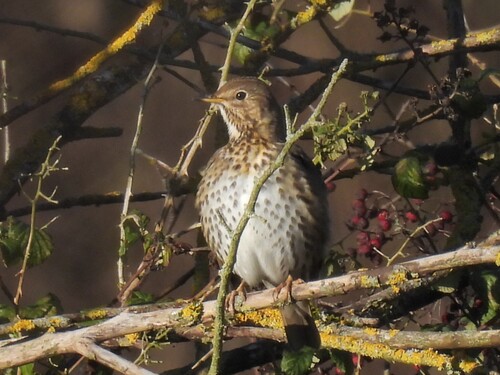 Song ThrushTurdus philomelosThe song thrush (as represented by the nominate subspecies T. p. philomelos) is 20 to 23.5 centimetres (7+3⁄4 to 9+1⁄4 inches) in length and weighs 50 to 107 grams (1+3⁄4 to 3+3⁄4 ounces).
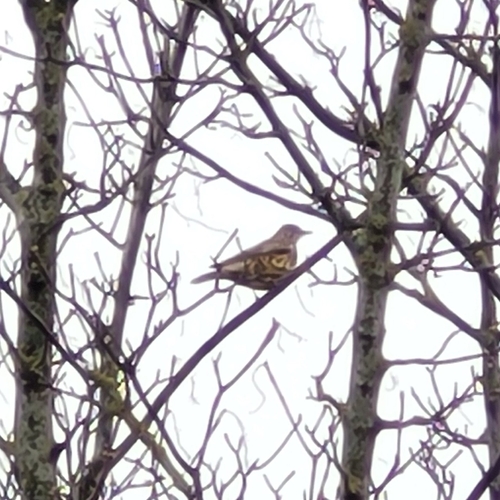 Mistle ThrushTurdus viscivorusThe mistle thrush is the largest thrush native to Europe.
Side by side: American Robin vs Fieldfare · Common Blackbird vs Fieldfare · Fieldfare vs Song Thrush · Fieldfare vs Wood Thrush · Fieldfare vs Redwing · Fieldfare vs Mistle Thrush
Learn the Fieldfare in the BeakBrain App
Photo and call practice. Coming soon to iPhone and Android.
Play today's Daily BirdEvery photo and recording on this page is credited to its author under the licence shown. Spotted a problem with this page, or have a better photo? Contribute.