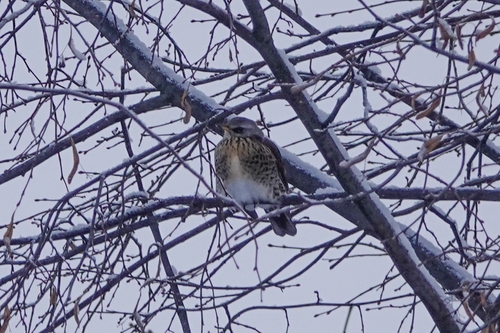
Fieldfare
Turdus pilaris
The fieldfare is easily recognisable with its slate-grey head, nape and rump, dark brown back, blackish tail and boldly speckled breast. In flight, its white under wing-coverts and axillaries are conspicuous. The harsh flight call "tsak tsak" is also distinctive. The forehead and crown of the male are bluish-grey and each feather has a central brownish-black band. The lores and under-eye regions are black and there are faint, pale streaks above the eyes. The ear-coverts, nape, hind neck and rump are bluish-grey, usually with a white streak near the shaft of each rump feather.
ID text from Wikipedia, CC BY-SA 4.0

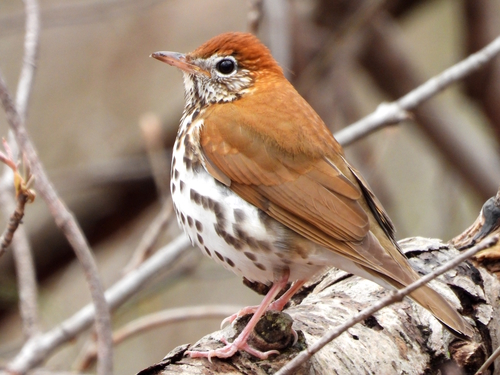
Wood Thrush
Hylocichla mustelina
The adult wood thrush is 18 to 21.5 cm (7.1 to 8.5 in) long, with a wingspan of 30 to 40 cm (12 to 16 in) and a body mass of 48 to 72 g (1.7 to 2.5 oz). Among standard measurements, the wing chord is 9.6 to 11.6 cm (3.8 to 4.6 in), the bill is 1.6 to 2 cm (0.63 to 0.79 in) and the tarsus is 2.8 to 3.3 cm (1.1 to 1.3 in). It is distinctly larger than the Catharus thrushes with which the species is often sympatric but slightly smaller than the common American robin. The longest known lifespan for a wood thrush in the wild is 8 years, 11 months. Voice: The wood thrush has been reported to have one of the most beautiful songs of North American birds. American naturalist Henry David Thoreau wrote: Whenever a man hears it he is young, and Nature is in her spring; wherever he hears it, it is a new world and a free country, and the gates of Heaven are not shut against him.
ID text from Wikipedia, CC BY-SA 4.0

Where you might meet both
Learn this pair in the BeakBrain App
Photo and call practice. Coming soon to iPhone and Android.
Play today's Daily BirdPhotos and recordings are credited to their authors under the licence shown. Full profiles: Fieldfare and Wood Thrush.