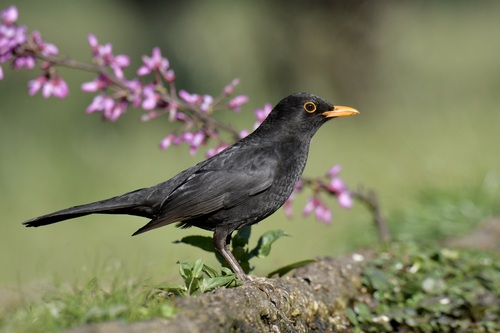
Common Blackbird
Turdus merula
In Europe, the common blackbird can be confused with the paler-winged first-winter ring ouzel (Turdus torquatus) or the superficially similar common starling (Sturnus vulgaris). A number of similar Turdus thrushes exist far outside the range of the common blackbird, for example the South American Chiguanco thrush (Turdus chiguanco). The Indian blackbird (Turdus simillimus), the Tibetan blackbird (Turdus maximus), and the Chinese blackbird (Turdus mandarinus) were formerly treated as subspecies of the common blackbird. The common blackbird of the nominate subspecies T. m. merula is 23. Voice: In its native range in the Northern Hemisphere, the first-year male common blackbird of the nominate race may start singing as early as late January in fine weather in order to establish a territory. This is followed in late March by the adult male.
ID text from Wikipedia, CC BY-SA 4.0

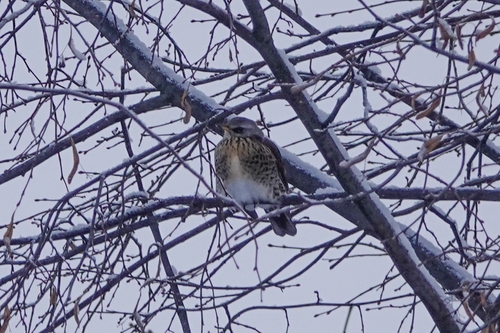
Fieldfare
Turdus pilaris
The fieldfare is easily recognisable with its slate-grey head, nape and rump, dark brown back, blackish tail and boldly speckled breast. In flight, its white under wing-coverts and axillaries are conspicuous. The harsh flight call "tsak tsak" is also distinctive. The forehead and crown of the male are bluish-grey and each feather has a central brownish-black band. The lores and under-eye regions are black and there are faint, pale streaks above the eyes. The ear-coverts, nape, hind neck and rump are bluish-grey, usually with a white streak near the shaft of each rump feather.
ID text from Wikipedia, CC BY-SA 4.0

Where you might meet both
And 41 more countries.
Learn this pair in the BeakBrain App
Photo and call practice. Coming soon to iPhone and Android.
Play today's Daily BirdPhotos and recordings are credited to their authors under the licence shown. Full profiles: Common Blackbird and Fieldfare.