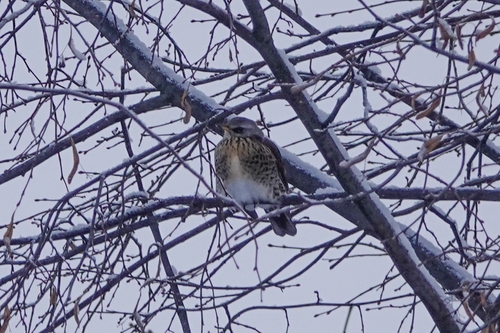
Fieldfare
Turdus pilaris
The fieldfare is easily recognisable with its slate-grey head, nape and rump, dark brown back, blackish tail and boldly speckled breast. In flight, its white under wing-coverts and axillaries are conspicuous. The harsh flight call "tsak tsak" is also distinctive. The forehead and crown of the male are bluish-grey and each feather has a central brownish-black band. The lores and under-eye regions are black and there are faint, pale streaks above the eyes. The ear-coverts, nape, hind neck and rump are bluish-grey, usually with a white streak near the shaft of each rump feather.
ID text from Wikipedia, CC BY-SA 4.0

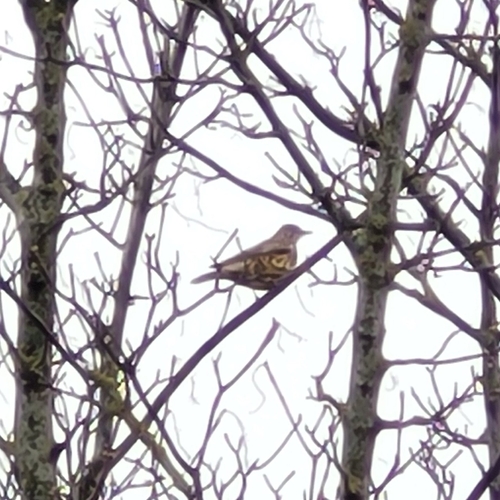
Mistle Thrush
Turdus viscivorus
The mistle thrush is the largest thrush native to Europe. The nominate subspecies measures 27–28 cm (11–11 in) in length, with a 45 cm (18 in) wingspan. It weighs 93 to 167 g (3.3 to 5.9 oz), with an average of around 130 g (4.6 oz). It has a stocky upright posture when on the ground. It has pale grey-brown upperparts, the chin and throat are greyish-white, and the yellowish-buff breast and off-white belly are marked with round black spots. The spotting becomes denser on the lower chest. The long tail has white tips on the outer feathers, and the underwing coverts are white. Voice: The male mistle thrush has a loud melodious song with fluted whistles, sounding like chewee-trewuu ... trureetruuruu or similar, repeated three to six times, and used to advertise his territory, attract a mate and maintain the pair bond. The tone resembles that of the song thrush or blackbird, but compared to its relatives the mistle thrush's repertoire is less varied and the delivery is slower.
ID text from Wikipedia, CC BY-SA 4.0

Where you might meet both
And 37 more countries.
Learn this pair in the BeakBrain App
Photo and call practice. Coming soon to iPhone and Android.
Play today's Daily BirdPhotos and recordings are credited to their authors under the licence shown. Full profiles: Fieldfare and Mistle Thrush.