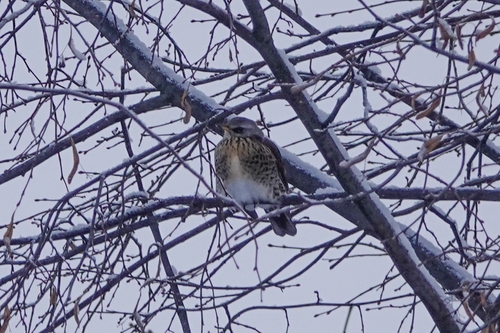
Fieldfare
Turdus pilaris
The fieldfare is easily recognisable with its slate-grey head, nape and rump, dark brown back, blackish tail and boldly speckled breast. In flight, its white under wing-coverts and axillaries are conspicuous. The harsh flight call "tsak tsak" is also distinctive. The forehead and crown of the male are bluish-grey and each feather has a central brownish-black band. The lores and under-eye regions are black and there are faint, pale streaks above the eyes. The ear-coverts, nape, hind neck and rump are bluish-grey, usually with a white streak near the shaft of each rump feather.
ID text from Wikipedia, CC BY-SA 4.0

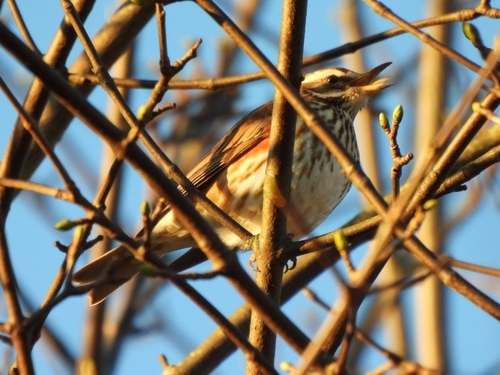
Redwing
Turdus iliacus
The thrush is 20–24 cm long with a wingspan of 33–34.5 cm and a weight of 50–75 g. The sexes are similar, with plain brown backs and with dark brown spots on the white underparts. The most striking identification features are the red flanks and underwing, and the creamy white stripe above the eye. Adults moult between June and September, which means that some start to replace their flight feathers while still feeding young. Voice: The male has a varied short song, and a whistling flight call. Redwings show a distinct dialectic variation in song, having a considerable similarity in song patterns among birds within a local population. The Redwing song consists of a number of introductory elements of descending or ascending frequency.
ID text from Wikipedia, CC BY-SA 4.0

Where you might meet both
And 38 more countries.
Learn this pair in the BeakBrain App
Photo and call practice. Coming soon to iPhone and Android.
Play today's Daily BirdPhotos and recordings are credited to their authors under the licence shown. Full profiles: Fieldfare and Redwing.