A forest is an ecosystem characterized by a dense community of trees. Hundreds of definitions of forest are used throughout the world, incorporating factors such as tree density, tree height, land use, legal standing, and ecological function.
A woodland is, in the broad sense, land covered with woody plants (trees and shrubs), or in a narrow sense, synonymous with wood (or in the United States, the plurale tantum woods), a low-density forest forming open habitats with plenty of sunlight and limited shade.
Shrubland, scrubland, scrub, brush, or bush is a plant community characterized by vegetation dominated by shrubs, often also including grasses, herbs, and geophytes.
A grassland is an area (or ecosystem) where the vegetation is dominated by grasses. Sedges and rushes can also be found along with some legumes such as clover and other herbs. Grasslands occur naturally on all continents except Antarctica and are found in most ecoregions of the Earth.
A wetland is a distinct semi-aquatic ecosystem whose groundcovers are flooded or saturated in water, either permanently, for years or decades, or only seasonally. Flooding results in oxygen-poor (anoxic) processes taking place, especially in the soils.
River ecosystems are flowing waters that drain the landscape, and include the biotic (living) interactions amongst plants, animals and micro-organisms, as well as abiotic (nonliving) physical and chemical interactions of its many parts.
A marine coastal ecosystem is a marine ecosystem which occurs where the land meets the ocean. Worldwide there is about 620,000 kilometres (390,000 mi) of coastline. Coastal habitats extend to the margins of the continental shelves, occupying about 7 percent of the ocean surface area.
Marine ecosystems are the largest of Earth's aquatic ecosystems and exist in waters that have a high salt content. These systems contrast with freshwater ecosystems, which have a lower salt content.
A desert is a landscape where little precipitation occurs and, consequently, living conditions create unique biomes and ecosystems. The lack of vegetation exposes the unprotected surface of the ground to denudation. About one-third of the land surface of the Earth is arid or semi-arid.
Bare rock with thin soil and little plant cover: inland cliffs, gorges, boulder fields and mountain crags. Sea cliffs count as coast.
AVONET habitat class “Rock”.
Urban
Urban wildlife refers to animal species that live in or frequently use urban and suburban areas, which are spaces dominated by human structures and activities, such as cities, towns, and surrounding neighborhoods.
An insectivore is a carnivorous animal or plant which eats insects. An alternative term is entomophage, which can also refer to the human practice of eating insects. The first vertebrate insectivores were amphibians.
Live prey with a backbone: mammals, birds, reptiles and amphibians. Fish and carrion have their own symbols, so neither counts here.
EltonTraits, the three vertebrate columns added together.
Fish
A piscivore is a carnivorous animal that primarily eats fish. Fish were the diet of early tetrapod evolution (via water-bound amphibians during the Devonian period); insectivory came next; then in time, the more terrestrially adapted reptiles and synapsids evolved herbivory.
A frugivore is an animal that thrives mostly on fruits. Approximately 20% of mammalian herbivores eat fruit. Frugivores are highly dependent on the abundance and nutritional composition of fruits.
In zoology, a nectarivore is an animal which derives its energy and nutrient requirements from a diet consisting mainly or exclusively of the sugar-rich nectar produced by flowering plants. Nectar as a food source presents a number of benefits as well as challenges.
Seed predation, often also called granivory, is a type of plant-animal interaction in which animals feed mainly on the seeds of plants. Granivores are found across many families of vertebrates, especially mammals and birds, as well as in many groups of insects.
A herbivore is an animal anatomically or physiologically evolved to feed on plants, especially upon vascular tissues such as foliage, fruits or seeds, as the main component of its diet.
Scavengers are animals that feed on dead and decaying organic matter. Often the term is used to describe the consumption of carrion, the bodies of animals that have died from causes other than predation or the bodies of animals that have been killed by other predators.
An omnivore is an animal that eats both plant and animal matter. Obtaining energy and nutrients from plant and animal matter, omnivores digest carbohydrates, protein, fat, and fiber, and metabolize the nutrients and energy of the sources absorbed.
The cup nest is smoothly hemispherical inside, with a deep depression to house the eggs. Most are made of pliable materials—including grasses—though a small number are made of mud or saliva.
The cavity nest is a chamber, typically in living or dead wood, but sometimes in the trunks of tree ferns or large cacti, including saguaro. In tropical areas, cavities are sometimes excavated in arboreal insect nests.
The sphere nest is a roundish structure; it is completely enclosed, except for a small opening which allows access. Most spherical nests are woven out of plant material. Spider webs are also frequently used, upon which other material such as lichens may be stuck for camouflage.
The platform nest is a large structure, often many times the size of the (typically large) bird which has built it. Depending on the species, these nests can be on the ground or elevated.
The simplest nest construction is the scrape, which is merely a shallow depression in soil or vegetation. This nest type, which typically has a rim deep enough to keep the eggs from rolling away, is sometimes lined with bits of vegetation, small stones, shell fragments or feathers.
A burrow is a hole or tunnel excavated into the ground by an animal to construct a space suitable for habitation or temporary refuge, or as a byproduct of locomotion.
The nest sits on the open ground with nothing dug or built for it: no burrow, no scrape, no structure recorded.
The eggs
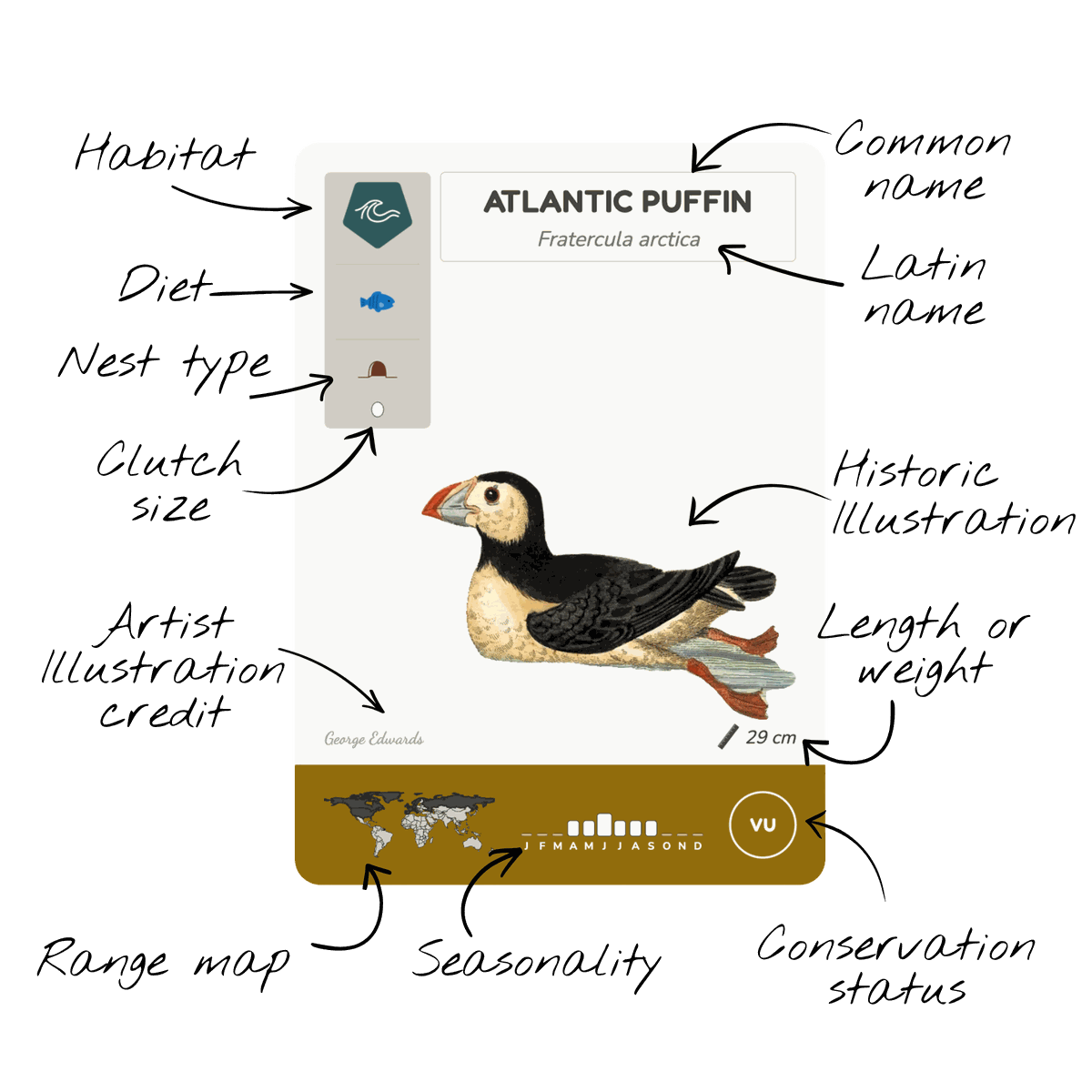
The eggs under the nest symbol are the average clutch, one for each egg laid. Rows hold four and stay balanced, so seven reads as four and three.
A clutch of seven.
Clutch sizes come from the Amniote life-history database, matched on scientific name and rounded. A species without a measured clutch shows no eggs. Drawing stops at twelve, with a plus for anything more.
Twelve and a plus: a greater rhea lays more.
Size
The card shows a length where one is known, and a mass otherwise. The label says which. Both describe the body, so wingspan appears nowhere on the card.
Length
A body length in centimetres, read from the species’ Wikipedia text: the first figure it gives, or the midpoint of a range, rounded.
Stated by around 55% of species.
Mass
Body mass in grams, from EltonTraits, falling back to AVONET. Grams below 1,000 g, kilograms above.
Shown for the remaining species.
Conservation status
The International Union for Conservation of Nature Red List of Threatened Species, also known as the IUCN Red List or Red Data Book, founded in 1964, is an inventory of the global conservation status and extinction risk of biological species.
Extinction is the termination of a species via the death of its last member. A taxon may become functionally extinct before the death of its last member if it loses the capacity to reproduce and recover.
A species that is extinct in the wild is one that has been categorized by the International Union for Conservation of Nature as only consisting of living members kept in captivity or as a naturalized population outside its historic range.
An IUCN Red List critically endangered (CR or sometimes CE) species is one that has been categorized by the International Union for Conservation of Nature as facing an extremely high risk of extinction in the wild.
An endangered species is a species that is very likely to become extinct in the near future, either worldwide or in a particular region. Endangered species may be at risk due to factors such as habitat loss, poaching, invasive species, and climate change.
A vulnerable species is a species that has been categorized by the International Union for Conservation of Nature as being threatened with extinction unless the circumstances that are threatening its survival and reproduction improve.
A near-threatened species is a species which has been categorized as "Near Threatened" by the International Union for Conservation of Nature as that may be vulnerable to endangerment in the near future, but it does not currently qualify for the threatened status.
A least-concern species is a species that has been evaluated and categorized by the International Union for Conservation of Nature as not being a focus of wildlife conservation because the specific species is still plentiful in the wild.
A data deficient species is one which has been categorized by the International Union for Conservation of Nature as offering insufficient information for a proper assessment of conservation.
A not evaluated species is one which has been categorized under the IUCN Red List of threatened species as not yet having been assessed by the International Union for Conservation of Nature.
Twelve bars along the foot of the card, January to December, with their initials beneath.
Present March to September, peak in May.
A month earns a full bar when it holds at least 4% of the year’s occurrence records, and a faint dash below that. The peak month is drawn tallest and widest.
Counts come from GBIF occurrence records.
The map
Residents only: vagrant records are left off. Countries come from GBIF occurrence records, the outline from Natural Earth at 1:110m.
A range across East Africa.
The illustration
4,695 cards carry a historical plate, drawn by ornithological illustrators and cut out of the book page it was printed on. 4,529 come from Wikimedia Commons and 166 from the Biodiversity Heritage Library. 4,105 are public domain, 51 are CC0, 111 are Creative Commons Attribution and 4 Attribution ShareAlike; the remaining 424 are files whose licence line the harvest did not capture.
Where a plate is missing, the card shows a PhyloPic silhouette for the family.
Trait data: diet, foraging stratum and activity:EltonTraits 1.0, CC BY 4.0Wilman, H., J. Belmaker, J. Simpson, C. de la Rosa, M. M. Rivadeneira and W. Jetz. 2014. EltonTraits 1.0: Species-level foraging attributes of the world’s birds and mammals. Ecology 95:2027.
Trait data: morphology, habitat and range:AVONET, CC BY 4.0Tobias, J. A., et al. 2022. AVONET: morphological, ecological and geographical data for all birds. Ecology Letters 25:581–597.
Nest type:A global database of bird nest traits, CC BY 4.0Chia, S. Y., Y.-T. Fang, Y.-T. Su, P.-Y. Tsai, C. Hsieh, S.-H. Tsao, J.-Y. Juang, C.-M. Hung and M.-N. Tuanmu. 2023. A global database of bird nest traits. Zenodo.
Clutch size, the eggs drawn on a card:Amniote life-history database, CC BY 4.0Myhrvold, N. P., E. Baldridge, B. Chan, D. Sivam, D. L. Freeman and S. K. M. Ernest. 2015. An amniote life-history database to perform comparative analyses with birds, mammals, and reptiles. Ecology 96:3109.
Family silhouettes, drawn when no plate exists:PhyloPic, CC0, public domain and CC BY only
The illustration on every card and species page: a plate from a historical bird book, scanned by Wikimedia Commons or the Biodiversity Heritage Library, cut to a single bird and cleared of its background. Public domain, CC0, Creative Commons Attribution and Attribution ShareAlike, per plate. The artist, the book and the year appear on the species page beneath the card.
Quoted symbol meanings:Wikipedia, CC BY-SA 4.0Retrieved 2026-08-12. Every quotation above links to the article or section it was taken from.
Habitat, diet, nest and size symbols: drawn by Cat Black for BeakBrain