Learn what every symbol on the card means.Full credits and sources at beakbrain.com/symbols
 WetlandScrapeSmall · 43 g


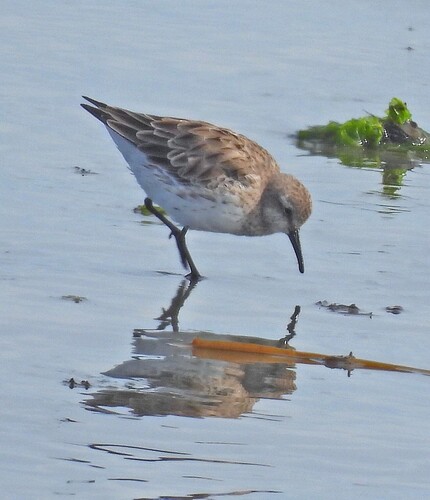
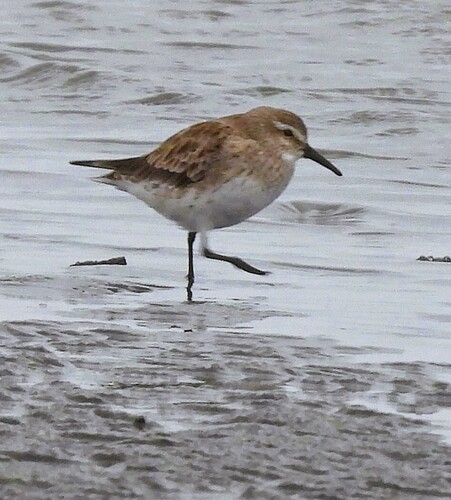
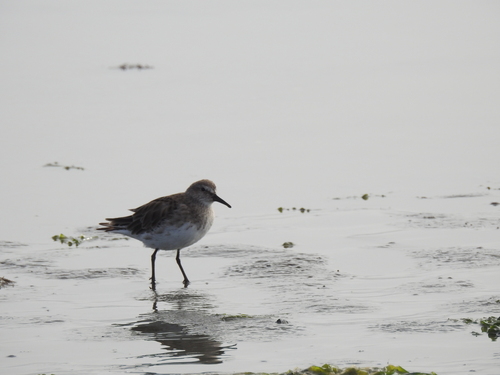
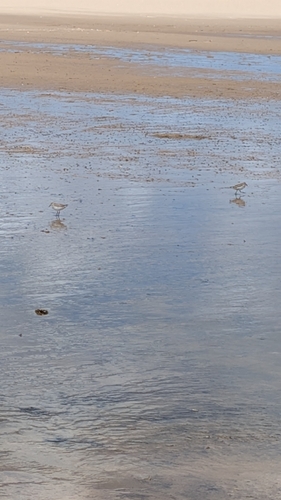
ID tip
The white-rumped sandpiper is a relatively small bird measuring only 15–18 cm (5.9–7.1 in), with a wingspan of 36–38 cm (14–15 in). The top of its body is a dull grey-brown colour and it has a white eye stripe. Its beak is of medium length, thin and dark, and its legs are very dark. This bird is often mistaken with many similar-looking sandpipers that live in its range or along its migration path. The plumage is much less distinct during the winter; however, during all seasons males and females remain similar in their appearance. Voice: One of the white-rumped sandpiper vocalizations consists of a repeating "pip, pip, pip …" Their call has a distinctive metallic "tzeep" note which makes them easily identifiable among a flock of shorebirds. It resembles the sound of two pebbles scraping against one another.
Text from Wikipedia, licensed CC BY-SA 4.0.
When to see the White-rumped Sandpiper
One bar for each month. Filled bars are the 6 months with records; pale bars are months with none. The wide bar is May, the month with the most records.
Where to see the White-rumped Sandpiper
The map shades 67 countries with regular records, and 10 more in a lighter tone where the bird turns up only as a stray. Everything unshaded has no records. Countries are listed below the map.
Recorded as a rare visitor in France, Belgium, Netherlands, Germany, Japan, Finland, Denmark, Switzerland, Namibia, St. Barthélemy.
About the White-rumped Sandpiper
The white-rumped sandpiper is a small migratory shorebird that breeds in the northern tundra of Canada and Alaska. This bird can be difficult to distinguish from other similar tiny shorebirds; these are known collectively as "peeps" or "stints". In flight, it is more easily picked out by its namesake white rump.
Text adapted from Wikipedia, licensed CC BY-SA 4.0.
Easily confused with
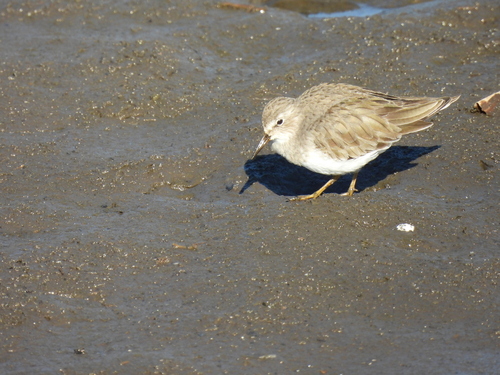 Temminck's StintCalidris temminckiiThese birds are very small waders, at 13.5–15 cm (5.3–5.9 in) length.
 Purple SandpiperCalidris maritimaAdults have short yellow legs and a medium thin dark bill with a yellow base.
 Baird's SandpiperCalidris bairdiiAdults have black legs and a short, straight, thin dark bill.
Side by side: Stilt Sandpiper vs White-rumped Sandpiper · Baird's Sandpiper vs White-rumped Sandpiper · Temminck's Stint vs White-rumped Sandpiper · Purple Sandpiper vs White-rumped Sandpiper
Learn the White-rumped Sandpiper in the BeakBrain App
Photo and call practice. Coming soon to iPhone and Android.
Play today's Daily BirdEvery photo and recording on this page is credited to its author under the licence shown. Spotted a problem with this page, or have a better photo? Contribute.