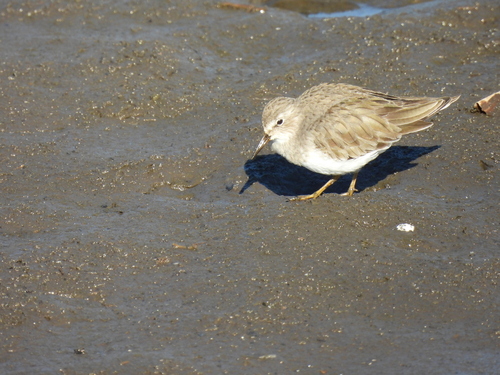
Temminck's Stint
Calidris temminckii
These birds are very small waders, at 13.5–15 cm (5.3–5.9 in) length. They are similar in size to the little stint (Calidris minuta) but shorter legged and longer winged. The legs are dull yellowish or brown, and the outer tail feathers white, in contrast to little stint's black legs and grey outer tail feathers. This is a rather drab wader, with mainly plain brown upperparts and head, and underparts white apart from a darker breast. The breeding adult has some brighter rufous and/or blackish mantle feathers to relieve the generally undistinguished appearance.
ID text from Wikipedia, CC BY-SA 4.0


White-rumped Sandpiper
Calidris fuscicollis
The white-rumped sandpiper is a relatively small bird measuring only 15–18 cm (5.9–7.1 in), with a wingspan of 36–38 cm (14–15 in). The top of its body is a dull grey-brown colour and it has a white eye stripe. Its beak is of medium length, thin and dark, and its legs are very dark. This bird is often mistaken with many similar-looking sandpipers that live in its range or along its migration path. The plumage is much less distinct during the winter; however, during all seasons males and females remain similar in their appearance. Voice: One of the white-rumped sandpiper vocalizations consists of a repeating "pip, pip, pip …" Their call has a distinctive metallic "tzeep" note which makes them easily identifiable among a flock of shorebirds. It resembles the sound of two pebbles scraping against one another.
ID text from Wikipedia, CC BY-SA 4.0
Where you might meet both
Learn this pair in the BeakBrain App
Photo and call practice. Coming soon to iPhone and Android.
Play today's Daily BirdPhotos and recordings are credited to their authors under the licence shown. Full profiles: Temminck's Stint and White-rumped Sandpiper.