Learn what every symbol on the card means.Full credits and sources at beakbrain.com/symbols
 ShrublandCup nestSmall · 24 g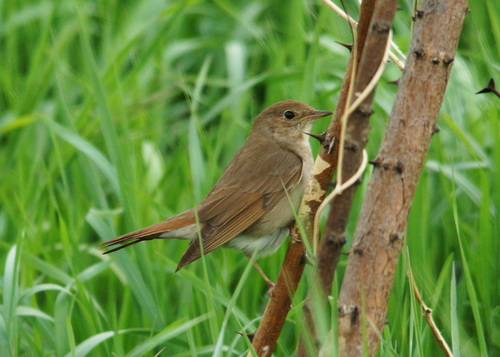


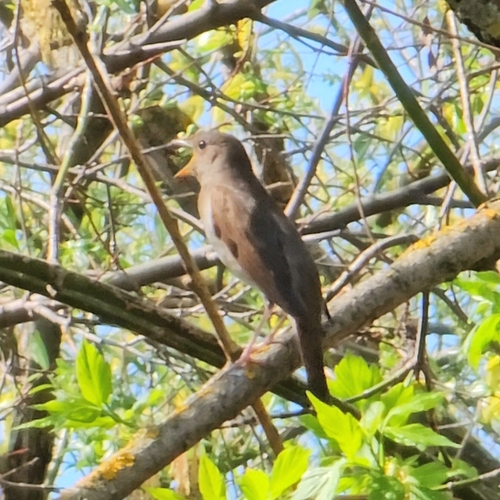
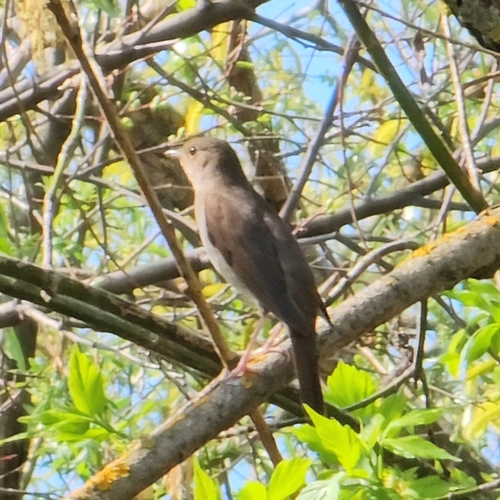


What the Thrush Nightingale sounds like


ID tip
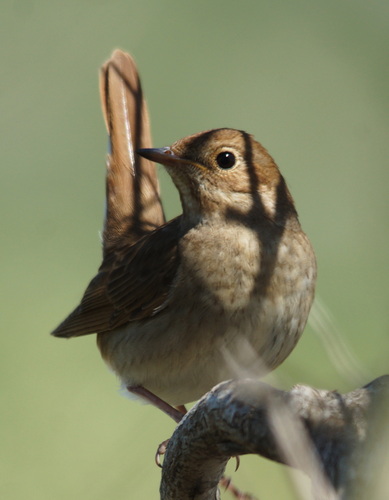
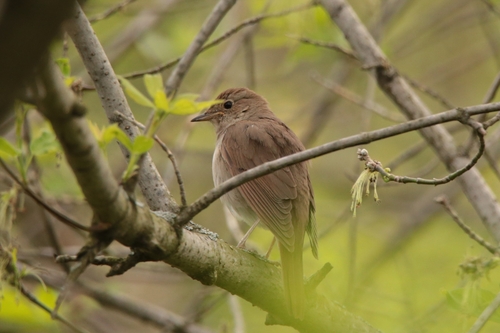
An adult thrush nightingale is about 16 centimetres (6.3 in) long with a wingspan of approximately 18 centimetres (7.1 in). The head, nape and the whole of the upper parts of the thrush nightingale are dark brown with a slight olive tinge. The colour is much deeper than that of the nightingale and is not at all rufous. The upper tail-coverts are less olivaceous and the tail feathers are dark rufous-brown. The lores and ear-coverts are brownish-black and the chin and throat are pale buff or whitish, mottled with brown, and are paler in colour than the nightingale. Voice: The male's song is loud, with a range of whistles, trills and clicks and includes a flute-like "pioo" with a pure bell-like tone. It is sometimes interrupted by a rasping "dserr" sound and is rather solemn as compared to that of the common nightingale. The song does not have that bird's loud whistling crescendo and is quite distinctive. It is also sometimes sung in the bird's winter quarters.
Text from Wikipedia, licensed CC BY-SA 4.0.
When to see the Thrush Nightingale
One bar for each month. Filled bars are the 4 months with records; pale bars are months with none. The wide bar is May, the month with the most records.
Where to see the Thrush Nightingale
The map shades 58 countries with regular records, and 12 more in a lighter tone where the bird turns up only as a stray. Everything unshaded has no records. Countries are listed below the map.
Recorded as a rare visitor in Belgium, Netherlands, France, Italy, Luxembourg, Libya, Albania, Switzerland, Croatia, Djibouti, Spain, Iceland.
About the Thrush Nightingale
The thrush nightingale, also known as the sprosser, is a small passerine bird in the Old World flycatcher family. It is a migratory species breeding in forests in Europe and the Palearctic and overwintering in Africa. An insectivore, it nests near the ground in dense undergrowth. Its distribution is more northerly than the very closely related common nightingale, which it closely resembles in appearance. Hybrids between the two have occurred in areas where their ranges overlap.
Text adapted from Wikipedia, licensed CC BY-SA 4.0.
Easily confused with
 BluethroatLuscinia svecicaThe male plumage is brightest in spring and summer; after the summer moult, the fresh new feathers have pale tips which obscure the throat pattern.
 White-bellied RedstartLuscinia phaenicuroidesThe white-bellied redstart is a species of bird of the family Muscicapidae.
 Common NightingaleLuscinia megarhynchosThe common nightingale is slightly larger than the European robin, at 15–16.5 cm (5.9–6.5 in) length.
Side by side: Common Nightingale vs Thrush Nightingale · Bluethroat vs Thrush Nightingale
Learn the Thrush Nightingale in the BeakBrain App
Photo and call practice. Coming soon to iPhone and Android.
Play today's Daily BirdEvery photo and recording on this page is credited to its author under the licence shown. Spotted a problem with this page, or have a better photo? Contribute.