Learn what every symbol on the card means.Full credits and sources at beakbrain.com/symbols
 WetlandSmall · 17 g


What the Bluethroat sounds like


ID tip
The male plumage is brightest in spring and summer; after the summer moult, the fresh new feathers have pale tips which obscure the throat pattern. These tips then abrade in late winter and early spring to reveal the brighter bases of the feathers. Females of all subspecies usually have just a blackish crescent and very limited blue on an otherwise cream throat and breast, though older individuals can develop more strongly male-like plumage.
Text from Wikipedia, licensed CC BY-SA 4.0.
When to see the Bluethroat
One bar for each month. Filled bars are the 11 months with records; pale bars are months with none. The wide bar is September, the month with the most records.
Where to see the Bluethroat
The map shades 90 countries with regular records, and 4 more in a lighter tone where the bird turns up only as a stray. Everything unshaded has no records. Countries are listed below the map.
Recorded as a rare visitor in Canada, Burkina Faso, Sudan, Macao SAR China.
About the Bluethroat
The bluethroat is a small passerine bird in the Old World flycatcher family. It is a migratory insectivorous species breeding in wet birch wood or bushy swamp in Europe and across the Palearctic with a foothold in western Alaska. It nests in tussocks or low in dense bushes. It winters in the Iberian Peninsula, the northern half of Africa, and in southern Asia. The bluethroat, and similar small European flycatchers, are often called chats.
Text adapted from Wikipedia, licensed CC BY-SA 4.0.
Easily confused with
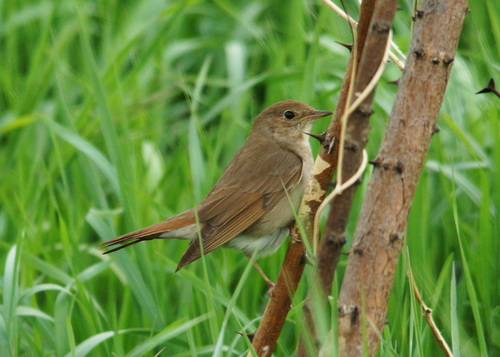 Thrush NightingaleLuscinia lusciniaAn adult thrush nightingale is about 16 centimetres (6.3 in) long with a wingspan of approximately 18 centimetres (7.1 in).
 Common NightingaleLuscinia megarhynchosThe common nightingale is slightly larger than the European robin, at 15–16.5 cm (5.9–6.5 in) length.
 White-bellied RedstartLuscinia phaenicuroidesThe white-bellied redstart is a species of bird of the family Muscicapidae.
Side by side: Bluethroat vs Common Nightingale · Bluethroat vs Thrush Nightingale
Learn the Bluethroat in the BeakBrain App
Photo and call practice. Coming soon to iPhone and Android.
Play today's Daily BirdEvery photo and recording on this page is credited to its author under the licence shown. Spotted a problem with this page, or have a better photo? Contribute.