
Bluethroat
Luscinia svecica
The male plumage is brightest in spring and summer; after the summer moult, the fresh new feathers have pale tips which obscure the throat pattern. These tips then abrade in late winter and early spring to reveal the brighter bases of the feathers. Females of all subspecies usually have just a blackish crescent and very limited blue on an otherwise cream throat and breast, though older individuals can develop more strongly male-like plumage.
ID text from Wikipedia, CC BY-SA 4.0

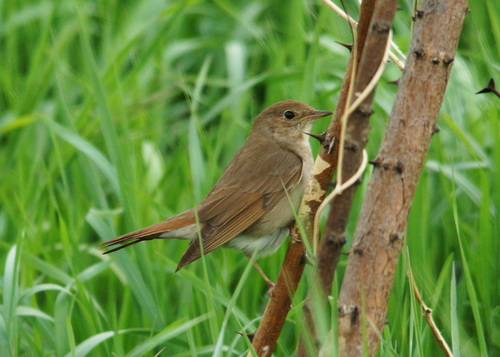
Thrush Nightingale
Luscinia luscinia
An adult thrush nightingale is about 16 centimetres (6.3 in) long with a wingspan of approximately 18 centimetres (7.1 in). The head, nape and the whole of the upper parts of the thrush nightingale are dark brown with a slight olive tinge. The colour is much deeper than that of the nightingale and is not at all rufous. The upper tail-coverts are less olivaceous and the tail feathers are dark rufous-brown. The lores and ear-coverts are brownish-black and the chin and throat are pale buff or whitish, mottled with brown, and are paler in colour than the nightingale. Voice: The male's song is loud, with a range of whistles, trills and clicks and includes a flute-like "pioo" with a pure bell-like tone. It is sometimes interrupted by a rasping "dserr" sound and is rather solemn as compared to that of the common nightingale. The song does not have that bird's loud whistling crescendo and is quite distinctive. It is also sometimes sung in the bird's winter quarters.
ID text from Wikipedia, CC BY-SA 4.0

Where you might meet both
And 21 more countries.
Learn this pair in the BeakBrain App
Photo and call practice. Coming soon to iPhone and Android.
Play today's Daily BirdPhotos and recordings are credited to their authors under the licence shown. Full profiles: Bluethroat and Thrush Nightingale.