Learn what every symbol on the card means.Full credits and sources at beakbrain.com/symbols
 ForestCup nestTiny · 6 g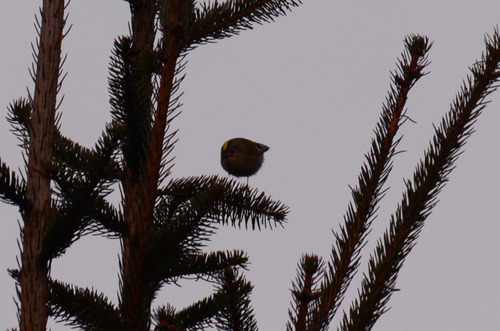

What the Goldcrest sounds like


ID tip
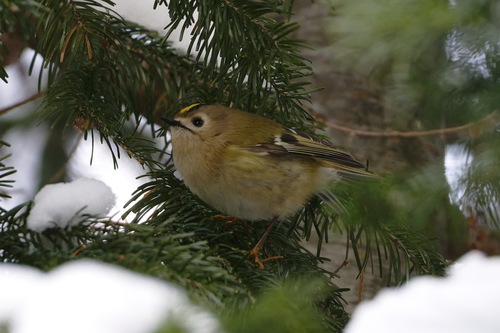
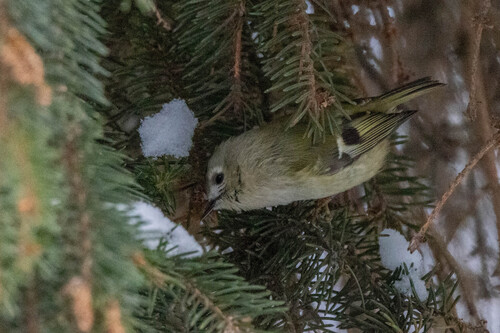
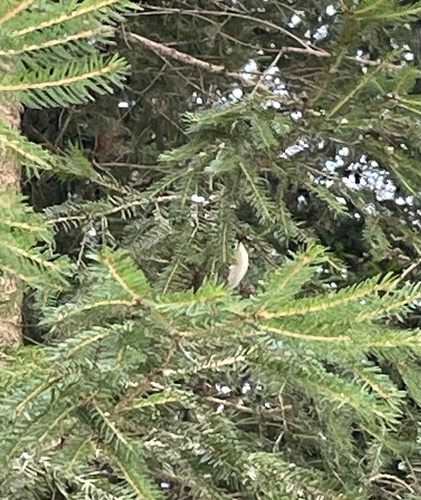
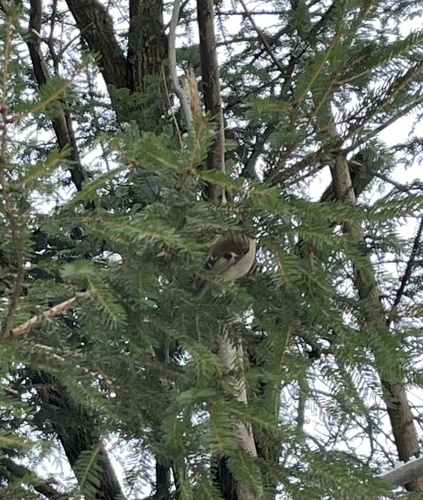
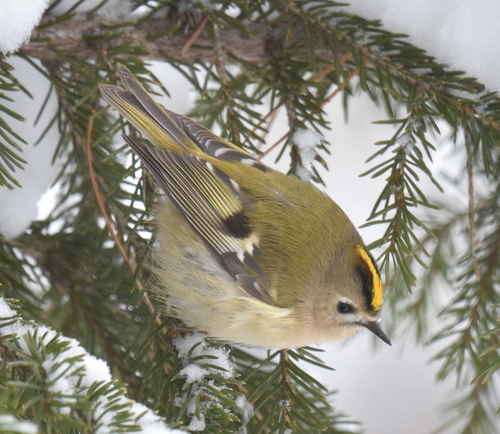
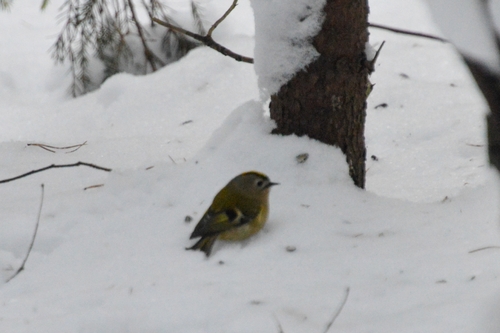
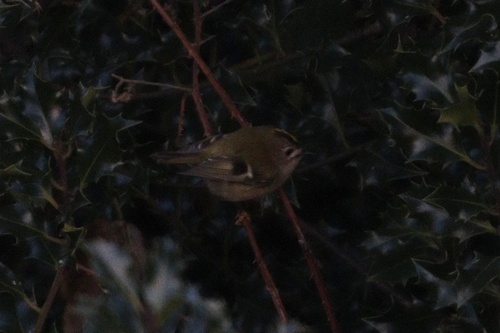
The goldcrest is the smallest European bird, 8.5–9.5 cm (3.3–3.7 in) in length, with a 13.5–15.5 cm (5.3–6.1 in) wingspan and a weight of 4.5–7.0 g (0.16–0.25 oz). It is similar in appearance to a warbler, with olive-green upper-parts, buff-white underparts, two white wing bars, and a plain face with conspicuous black irises. The crown of the head has black sides and a narrow black front, and a bright crest, yellow with an orange centre in the male, and entirely yellow in the female; the crest is erected in display, making the distinctive orange stripe of the male much more conspicuous. Voice: The typical contact call of the goldcrest is a thin, high-pitched zee given at intervals of 1–4 seconds, with all the notes at the same pitch. It sometimes has a more clipped ending, or is delivered more rapidly. The call is higher and less rough than that of the firecrest.
Text from Wikipedia, licensed CC BY-SA 4.0.
When to see the Goldcrest
One bar for each month. Filled bars are the 9 months with records; pale bars are months with none. The wide bar is October, the month with the most records.
Where to see the Goldcrest
The map shades 74 countries with regular records, and 3 more in a lighter tone where the bird turns up only as a stray. Everything unshaded has no records. Countries are listed below the map.
Recorded as a rare visitor in Morocco, Myanmar (Burma), Gibraltar.
About the Goldcrest
The goldcrest is a very small passerine bird in the kinglet family. Its colourful golden crest feathers, as well as being called the "king of the birds" in European folklore, gives rise to its English and scientific names. The scientific name, R. regulus, means 'petty king' or prince. Several subspecies are recognised across the very large distribution range that includes much of the Palearctic and the islands of Macaronesia and Iceland. Birds from the north and east of its breeding range migrate to winter further south.
Text adapted from Wikipedia, licensed CC BY-SA 4.0.
Easily confused with
 Golden-crowned KingletRegulus satrapaAdults are olive-gray on the upperparts with white underparts, thin bills and short tails.
 Common FirecrestRegulus ignicapillaThe common firecrest is a small plump bird, 9 cm (3.5 in) in length with a wingspan of 13–16 cm (5.1–6.3 in), and weighs 4–7 grams (0.14–0.25 oz).
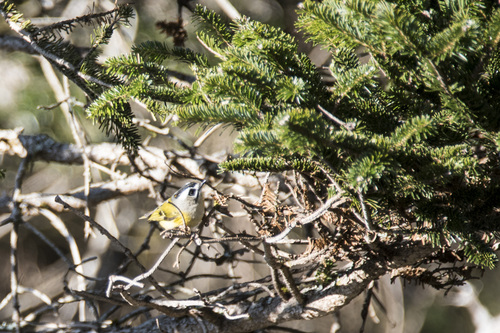 FlamecrestRegulus goodfellowiThe flamecrest is a small perching bird, resembling a warbler.
Side by side: Goldcrest vs Ruby-crowned Kinglet · Goldcrest vs Golden-crowned Kinglet · Common Firecrest vs Goldcrest · Flamecrest vs Goldcrest
Learn the Goldcrest in the BeakBrain App
Photo and call practice. Coming soon to iPhone and Android.
Play today's Daily BirdEvery photo and recording on this page is credited to its author under the licence shown. Spotted a problem with this page, or have a better photo? Contribute.