Learn what every symbol on the card means.Full credits and sources at beakbrain.com/symbols
 ForestCup nestTiny · 6 g


What the Common Firecrest sounds like


ID tip
The common firecrest is a small plump bird, 9 cm (3.5 in) in length with a wingspan of 13–16 cm (5.1–6.3 in), and weighs 4–7 grams (0.14–0.25 oz). It has bright olive-green upperparts with a bronze-coloured patch on each shoulder, and whitish underparts washed with brownish-grey on the breast and flanks. It has two white wingbars, a tiny black pointed bill, and brownish-black legs. The head pattern is striking, with a black eye stripe, long white supercilium, and a crest which is bright yellow in the female and mainly orange in the male. Voice: The contact call is three or four thin high notes, similar to that of goldcrest, but slightly lower in pitch, zit-zit-zit rather than see-see-see. The song is a succession of call notes in a longer and slightly more varied sequence.
Text from Wikipedia, licensed CC BY-SA 4.0.
When to see the Common Firecrest
One bar for each month. Filled bars are the 10 months with records; pale bars are months with none. The wide bar is May, the month with the most records.
Where to see the Common Firecrest
The map shades 53 countries with regular records. Everything unshaded has no records. Countries are listed below the map.
About the Common Firecrest
The common firecrest, also known as the firecrest, is a very small passerine bird in the kinglet family. It breeds in most of temperate Europe and northwestern Africa, and is partially migratory, with birds from central Europe wintering to the south and west of their breeding range. Firecrests in the Balearic Islands and north Africa are widely recognised as a separate subspecies, but the population on Madeira, previously also treated as a subspecies, is now treated as a distinct species, the Madeira firecrest, Regulus madeirensis. A fossil ancestor of the firecrest has been identified from a single wing bone.
Text adapted from Wikipedia, licensed CC BY-SA 4.0.
Easily confused with
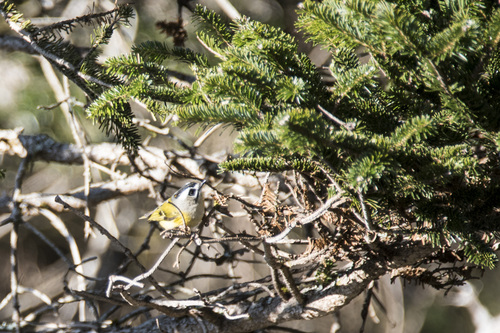 FlamecrestRegulus goodfellowiThe flamecrest is a small perching bird, resembling a warbler.
 Madeira FirecrestRegulus madeirensisThe Madeira firecrest is a small plump bird, of 9–10 cm (3.5–3.9 in) length and weighing about 5 g (0.18 oz).
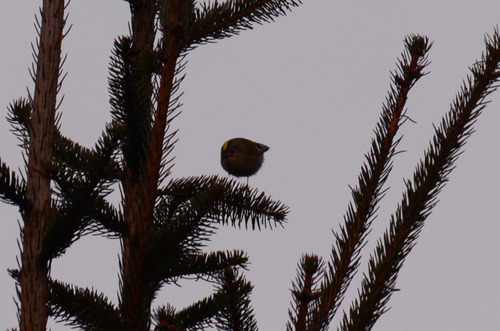 GoldcrestRegulus regulusThe goldcrest is the smallest European bird, 8.5–9.5 cm (3.3–3.7 in) in length, with a 13.5–15.5 cm (5.3–6.1 in) wingspan and a weight of 4.5–7.0 g (0.16–0.25 oz).
Side by side: Common Firecrest vs Ruby-crowned Kinglet · Common Firecrest vs Golden-crowned Kinglet · Common Firecrest vs Goldcrest · Common Firecrest vs Flamecrest
Learn the Common Firecrest in the BeakBrain App
Photo and call practice. Coming soon to iPhone and Android.
Play today's Daily BirdEvery photo and recording on this page is credited to its author under the licence shown. Spotted a problem with this page, or have a better photo? Contribute.