Learn what every symbol on the card means.Full credits and sources at beakbrain.com/symbols
 ShrublandCup nestSmall · 20 g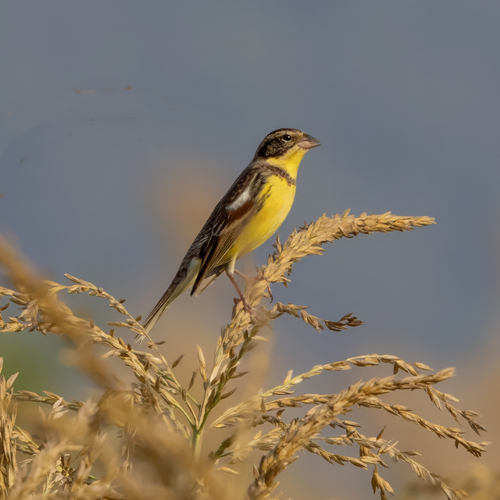


ID tip
The yellow-breasted bunting is a small passerine, ranging from 14 to 16 cm (5.5 to 6.3 in) in length, and weighing 17 to 26 g (0.6 to 0.9 oz). For a bunting, it is large and rather stocky. The breeding male has bright white underparts with black flank streaks, brown upperparts, black face and throat bar, and a pink lower mandible. The female has a heavily streaked grey-brown back, and less intensely yellow underparts. She has a whitish face with dark crown, eye and cheek stripes. The juvenile is similar, but the background colour of the underparts and face is buff.
Text from Wikipedia, licensed CC BY-SA 4.0.
When to see the Yellow-breasted Bunting
One bar for each month. Filled bars are the 10 months with records; pale bars are months with none. The wide bar is April, the month with the most records.
Where to see the Yellow-breasted Bunting
The map shades 22 countries with regular records, and 11 more in a lighter tone where the bird turns up only as a stray. Everything unshaded has no records. Countries are listed below the map.
Recorded as a rare visitor in United Kingdom, Norway, Belgium, United States, France, Italy, Canada, China, Spain, Israel, Pakistan.
About the Yellow-breasted Bunting
The yellow-breasted bunting is a passerine bird in the bunting family Emberizidae that is found across the Boreal and East Palearctic. The genus name Emberiza is from Old German Embritz, a bunting. The specific aureola is Latin for "golden". The bird's call is a distinctive zick, and the song is a clear tru-tru, tri-tri.
Text adapted from Wikipedia, licensed CC BY-SA 4.0.
Easily confused with
 Chestnut-eared BuntingEmberiza fucataIt is 15 to 16 cm in length.
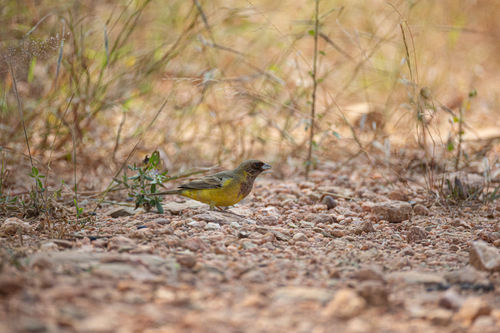 Red-headed BuntingEmberiza brunicepsThe red-headed bunting is a passerine bird in the bunting family Emberizidae.
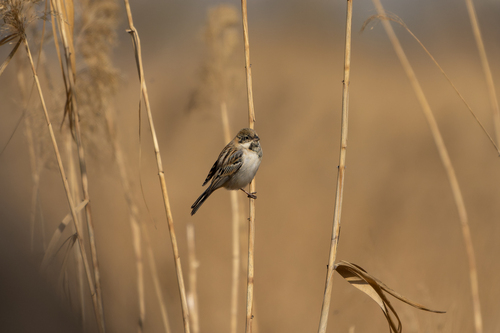 Pallas's Reed BuntingEmberiza pallasiPallas's reed bunting is a small passerine bird, similar to a small reed bunting and possesses a small granivore-type bill.
Side by side: Pallas's Reed Bunting vs Yellow-breasted Bunting · Chestnut-eared Bunting vs Yellow-breasted Bunting
Learn the Yellow-breasted Bunting in the BeakBrain App
Photo and call practice. Coming soon to iPhone and Android.
Play today's Daily BirdEvery photo and recording on this page is credited to its author under the licence shown. Spotted a problem with this page, or have a better photo? Contribute.