Learn what every symbol on the card means.Full credits and sources at beakbrain.com/symbols
 ShrublandCup nestSmall · 17 g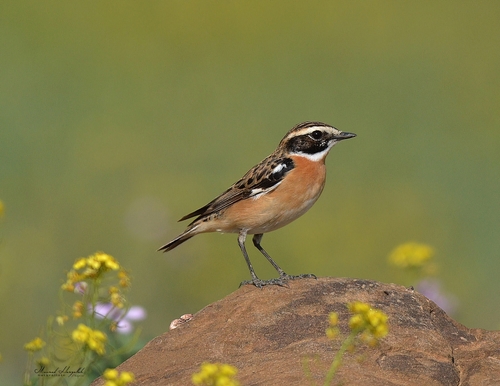


What the Whinchat sounds like


ID tip
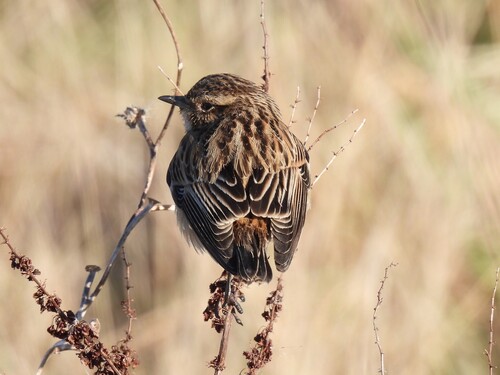
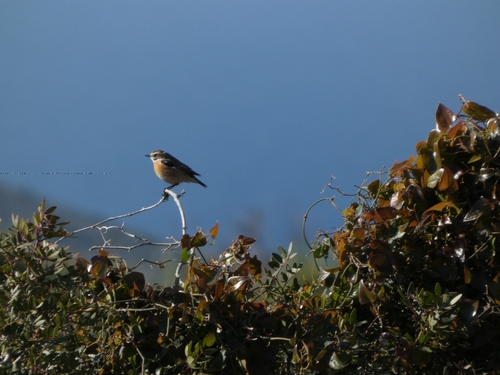
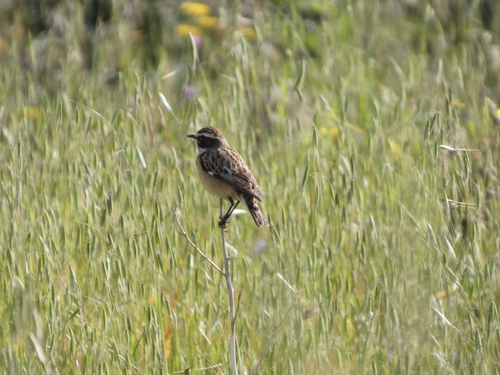
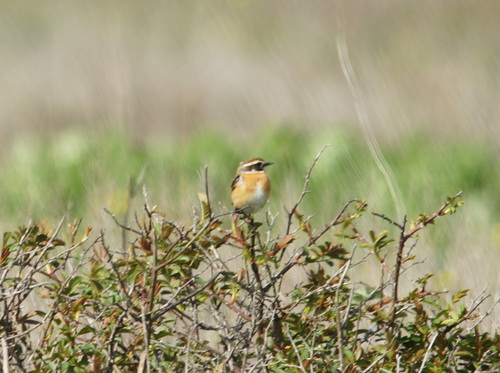
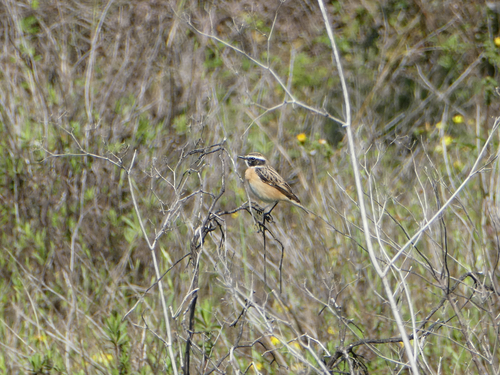
The whinchat is a short-tailed bird, moving on the ground with small, rapid hops and frequently bobbing and flicking its wings and tail. It is similar in size to its relative the European robin (Erithacus rubecula), being 12 to 14 cm (4.7 to 5.5 in) long and weighing 13 to 26 g (0.46 to 0.92 oz). Both sexes have brownish upperparts mottled darker, a buff throat and breast, a pale buff to whitish belly, and a blackish tail with white bases to the outer tail feathers.
Text from Wikipedia, licensed CC BY-SA 4.0.
When to see the Whinchat
One bar for each month. Filled bars are the 6 months with records; pale bars are months with none. The wide bar is May, the month with the most records.
Where to see the Whinchat
The map shades 104 countries with regular records, and 6 more in a lighter tone where the bird turns up only as a stray. Everything unshaded has no records. Countries are listed below the map.
Recorded as a rare visitor in India, Japan, Sri Lanka, Sudan, São Tomé & Príncipe, Somalia.
About the Whinchat
The whinchat is a small migratory passerine bird breeding in Europe and western Asia and wintering in central Africa. At one time considered to be in the thrush family, Turdidae, it is now placed in the Old World flycatcher family, Muscicapidae. Both sexes have a strong supercilium, brownish upper parts mottled darker, a pale throat and breast, a pale buff to whitish belly, and a blackish tail with white bases to the outer tail feathers, but in the breeding season, the male has an orange-buff throat and breast.
Text adapted from Wikipedia, licensed CC BY-SA 4.0.
Easily confused with
 Pied Bush ChatSaxicola caprataAt 13 cm (5.1 in), the pied bush chat is slightly smaller than the Siberian stonechat, Saxicola maurus, although it has a similar dumpy structure and upright stance.
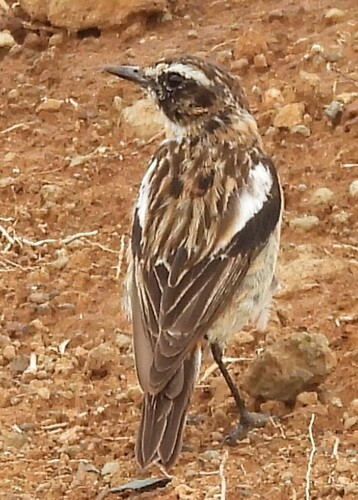
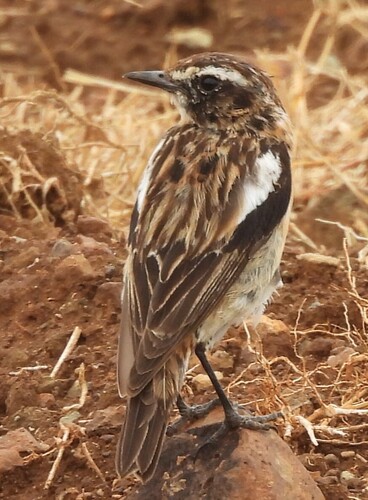
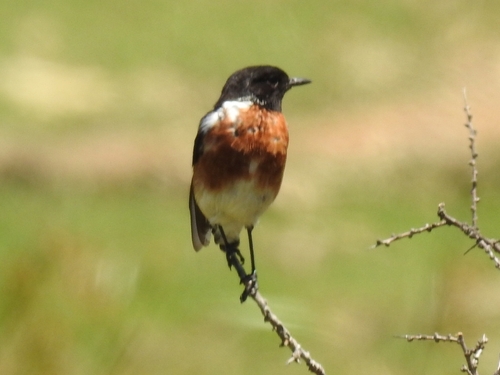 African StonechatSaxicola torquatusThe males have a black head, a white half-collar, a black back, a white rump, and a black tail; the wings are black with a large white patch on the top side of the inner wing.
 European StonechatSaxicola rubicolaThe stonechat is 11.5–13 cm (4.5–5.1 in) long and weighs 13–17 g (0.46–0.60 oz), slightly smaller than the European robin.
Side by side: European Stonechat vs Whinchat · Pied Bush Chat vs Whinchat · African Stonechat vs Whinchat
Learn the Whinchat in the BeakBrain App
Photo and call practice. Coming soon to iPhone and Android.
Play today's Daily BirdEvery photo and recording on this page is credited to its author under the licence shown. Spotted a problem with this page, or have a better photo? Contribute.