Learn what every symbol on the card means.Full credits and sources at beakbrain.com/symbols
 ShrublandCavity nestTiny · 14 g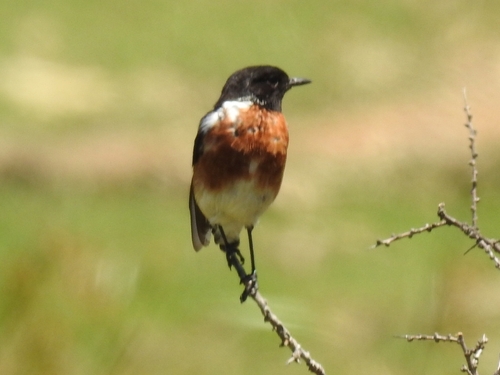


ID tip
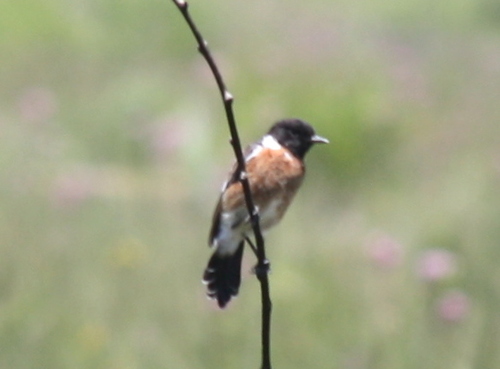
The males have a black head, a white half-collar, a black back, a white rump, and a black tail; the wings are black with a large white patch on the top side of the inner wing. The upper breast is usually dark orange-red, with a sharp or gradual transition to white or pale orange on the lower breast and belly depending on subspecies. In a few, black replaces the orange breast feathers in part or entirely. Females have brown rather than black above and on the head with an indistinct paler eyebrow line, chestnut-buff rather than orange below, and less white on the wings.
Text from Wikipedia, licensed CC BY-SA 4.0.
When to see the African Stonechat
One bar for each month, and every month is filled: this bird is recorded here in all twelve. The wide bar is October, the month with the most records.
Where to see the African Stonechat
The map shades 65 countries with regular records, and 15 more in a lighter tone where the bird turns up only as a stray. Everything unshaded has no records. Countries are listed below the map.
Recorded as a rare visitor in Netherlands, India, Norway, Denmark, Georgia, Thailand, Côte d’Ivoire, Sierra Leone, Somalia, Nepal, Belarus, Egypt, Sudan, Liechtenstein, North Macedonia.
About the African Stonechat
The African stonechat or common stonechat is a species of the Old World flycatcher family (Muscicapidae), inhabiting sub-Saharan Africa and adjacent regions. Like the other chats, it was long assigned to the thrush family (Turdidae), to which the chats are convergent. Its scientific name refer to its appearance and habitat and means "collared rock-dweller": Saxicola from Latin saxum ("rock") + incola, torquatus, Latin for "collared".
Text adapted from Wikipedia, licensed CC BY-SA 4.0.
Easily confused with
 Pied Bush ChatSaxicola caprataAt 13 cm (5.1 in), the pied bush chat is slightly smaller than the Siberian stonechat, Saxicola maurus, although it has a similar dumpy structure and upright stance.
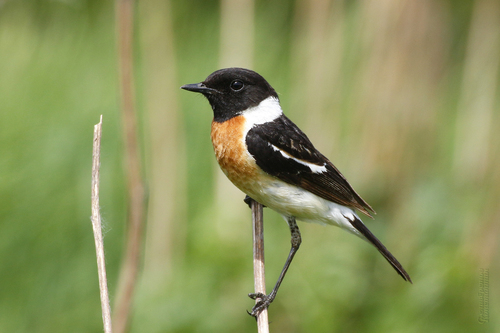 Siberian StonechatSaxicola maurusSiberian stonechat resembles its close relative relative the European stonechat (S. rubicola), but is typically darker above and paler below, with a white rump and whiter underparts with less orange on the breast.
 Grey Bush ChatSaxicola ferreusThe grey bush chat is a species of passerine bird in the family Muscicapidae.
Side by side: African Stonechat vs European Stonechat · African Stonechat vs Whinchat · African Stonechat vs Pied Bush Chat · African Stonechat vs Siberian Stonechat
Learn the African Stonechat in the BeakBrain App
Photo and call practice. Coming soon to iPhone and Android.
Play today's Daily BirdEvery photo and recording on this page is credited to its author under the licence shown. Spotted a problem with this page, or have a better photo? Contribute.