African Stonechat
Saxicola torquatus
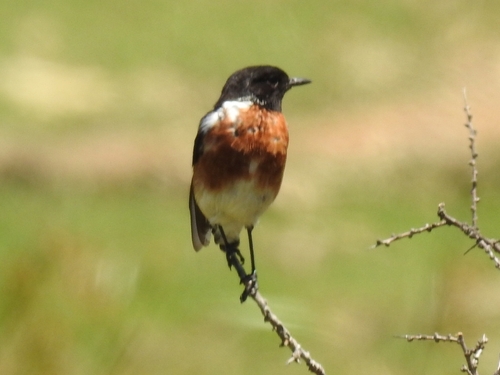
The males have a black head, a white half-collar, a black back, a white rump, and a black tail; the wings are black with a large white patch on the top side of the inner wing. The upper breast is usually dark orange-red, with a sharp or gradual transition to white or pale orange on the lower breast and belly depending on subspecies. In a few, black replaces the orange breast feathers in part or entirely. Females have brown rather than black above and on the head with an indistinct paler eyebrow line, chestnut-buff rather than orange below, and less white on the wings.
ID text from Wikipedia, CC BY-SA 4.0

European Stonechat
Saxicola rubicola
The stonechat is 11.5–13 cm (4.5–5.1 in) long and weighs 13–17 g (0.46–0.60 oz), slightly smaller than the European robin. Both sexes have distinctively short wings, shorter than those of the more migratory whinchat and Siberian stonechat. The summer male has black upperparts, a black head, an orange throat and breast, and a white belly and vent. It also has a white half-collar on the sides of its neck, a small white scapular patch on the wings, and a very small white patch on the rump often streaked with black.
ID text from Wikipedia, CC BY-SA 4.0

Where you might meet both
And 8 more countries.
Learn this pair in the BeakBrain App
Photo and call practice. Coming soon to iPhone and Android.
Play today's Daily BirdPhotos and recordings are credited to their authors under the licence shown. Full profiles: African Stonechat and European Stonechat.