Learn what every symbol on the card means.Full credits and sources at beakbrain.com/symbols
 ForestCup nestMedium · 106 g


What the Tui sounds like

ID tip
The tūī is a large honeyeater, 27 to 32 cm (11–13 in) in length. The Chatham Islands subspecies is larger on average than the nominate subspecies, and heavier. Males tend to be heavier than females. Nominate males weigh between 65–150 g (2.3–5.3 oz), and females 58–105 g (2.0–3.7 oz). Males of the Chatham subspecies are 89–240 g (3.1–8.5 oz) and females 89–170 g (3.1–6.0 oz). At first glance the bird appears completely black except for a small tuft of white feathers at its neck and a small white wing patch, causing it to resemble a parson in clerical attire. Voice: Tūī are known for their noisy, unusual, sometimes soulful calls, different for each individual, that combine bellbird-like notes with clicks, cackles, timber-like creaks and groans, and wheezing sounds. Tūī have a complex variety of songs and calls, much like parrots.
Text from Wikipedia, licensed CC BY-SA 4.0.
When to see the Tui
One bar for each month, and every month is filled: this bird is recorded here in all twelve. The wide bar is November, the month with the most records.
Where to see the Tui
The map shades 1 country with regular records. Everything unshaded has no records. Countries are listed below the map.
About the Tui
The tūī is a medium-sized bird native to New Zealand. It is blue, green, and bronze coloured with a distinctive white throat tuft (poi). It is an endemic passerine bird of New Zealand, and the only species in the genus Prosthemadera. It is one of the largest species in the diverse Australasian honeyeater family Meliphagidae, and one of two living species of that family found in New Zealand, the other being the New Zealand bellbird. The tūī has a wide distribution in the archipelago, ranging from the subtropical Kermadec Islands to the sub-Antarctic Auckland Islands, as well as the main islands.
Text adapted from Wikipedia, licensed CC BY-SA 4.0.
Easily confused with
 Blue-faced HoneyeaterEntomyzon cyanotisA large honeyeater ranging from 26 to 32 cm (10 to 12.5 in) and averaging 29.5 cm (11.6 in) in length.
 Noisy FriarbirdPhilemon corniculatusMeasuring 31–36 cm (12–14 in) in length, the noisy friarbird is a large honeyeater with dull brownish grey upperparts and paler brown-grey underparts.
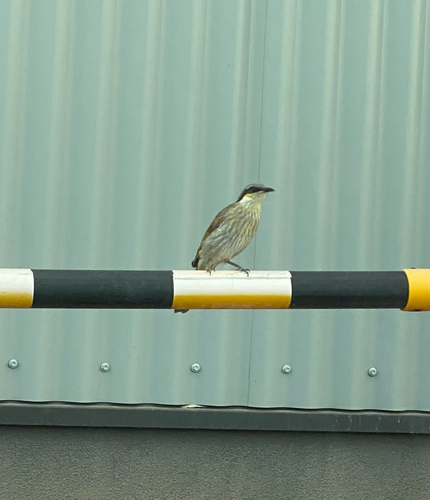 Singing HoneyeaterGavicalis virescensSinging honeyeaters can vary in length from 17–22 cm (6.7–8.7 in).
Side by side: Noisy Friarbird vs Tui · Blue-faced Honeyeater vs Tui · Singing Honeyeater vs Tui
Learn the Tui in the BeakBrain App
Photo and call practice. Coming soon to iPhone and Android.
Play today's Daily BirdEvery photo and recording on this page is credited to its author under the licence shown. Spotted a problem with this page, or have a better photo? Contribute.