Learn what every symbol on the card means.Full credits and sources at beakbrain.com/symbols
 ForestDomed nestMedium · 105 g


ID tip
A large honeyeater ranging from 26 to 32 cm (10 to 12.5 in) and averaging 29.5 cm (11.6 in) in length. The adult blue-faced honeyeater has a wingspan of 44 cm (17.5 in) and weighs around 105 g (3.7 oz). In general shape, it has broad wings with rounded tips and a medium squarish tail. The sturdy, slightly downcurved bill is shorter than the skull, and measures 3 to 3.5 cm (1.2 to 1.4 in) in length. It is easily recognised by the bare blue skin around its eyes. The head and throat are otherwise predominantly blackish with a white stripe around the nape and another from the cheek.
Text from Wikipedia, licensed CC BY-SA 4.0.
When to see the Blue-faced Honeyeater
One bar for each month, and every month is filled: this bird is recorded here in all twelve. The wide bar is October, the month with the most records.
Where to see the Blue-faced Honeyeater
The map shades 3 countries with regular records. Everything unshaded has no records. Countries are listed below the map.
About the Blue-faced Honeyeater
The blue-faced honeyeater, also colloquially known as the bananabird, is a passerine bird of the honeyeater family, Meliphagidae. It is the only member of its genus, and it is most closely related to honeyeaters of the genus Melithreptus. Three subspecies are recognised. At around 29.5 cm (11.6 in) in length, the blue-faced species is large for a honeyeater. Its plumage is distinctive, with olive upperparts, white underparts, and a black head and throat with white nape and cheeks. Males and females are similar in external appearance. Adults have a blue area of bare skin on each side of the face readily distinguishing them from juveniles, which have yellow or green patches of bare skin.
Text adapted from Wikipedia, licensed CC BY-SA 4.0.
Easily confused with
 TuiProsthemadera novaeseelandiaeThe tūī is a large honeyeater, 27 to 32 cm (11–13 in) in length.
 Noisy FriarbirdPhilemon corniculatusMeasuring 31–36 cm (12–14 in) in length, the noisy friarbird is a large honeyeater with dull brownish grey upperparts and paler brown-grey underparts.
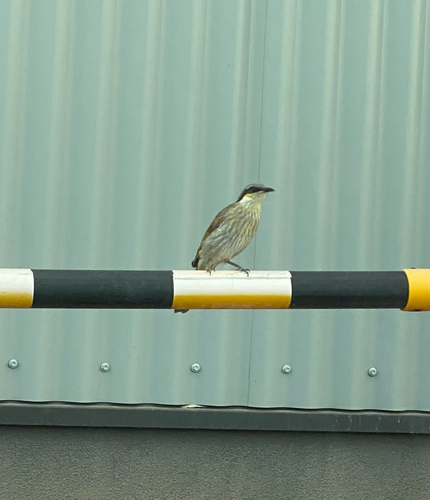 Singing HoneyeaterGavicalis virescensSinging honeyeaters can vary in length from 17–22 cm (6.7–8.7 in).
Side by side: Blue-faced Honeyeater vs Tui · Blue-faced Honeyeater vs Noisy Friarbird · Blue-faced Honeyeater vs Singing Honeyeater
Learn the Blue-faced Honeyeater in the BeakBrain App
Photo and call practice. Coming soon to iPhone and Android.
Play today's Daily BirdEvery photo and recording on this page is credited to its author under the licence shown. Spotted a problem with this page, or have a better photo? Contribute.