
Blue-faced Honeyeater
Entomyzon cyanotis
A large honeyeater ranging from 26 to 32 cm (10 to 12.5 in) and averaging 29.5 cm (11.6 in) in length. The adult blue-faced honeyeater has a wingspan of 44 cm (17.5 in) and weighs around 105 g (3.7 oz). In general shape, it has broad wings with rounded tips and a medium squarish tail. The sturdy, slightly downcurved bill is shorter than the skull, and measures 3 to 3.5 cm (1.2 to 1.4 in) in length. It is easily recognised by the bare blue skin around its eyes. The head and throat are otherwise predominantly blackish with a white stripe around the nape and another from the cheek.
ID text from Wikipedia, CC BY-SA 4.0
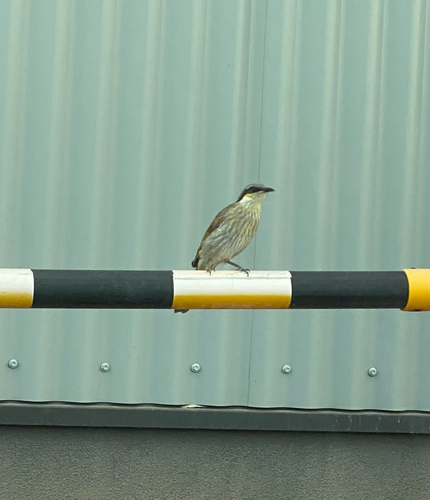
Singing Honeyeater
Gavicalis virescens
Singing honeyeaters can vary in length from 17–22 cm (6.7–8.7 in). Their overall appearance is grey-brown. The tail and wings are olive-green with flashes of yellow. There is a broad, black stripe running from the behind the beak to the back, and a yellow streak immediately below this from the eye. The bird's song ranges from scratchy to melodious. The song also varies according to where they live.
ID text from Wikipedia, CC BY-SA 4.0
Where you might meet both
Learn this pair in the BeakBrain App
Photo and call practice. Coming soon to iPhone and Android.
Play today's Daily BirdPhotos and recordings are credited to their authors under the licence shown. Full profiles: Blue-faced Honeyeater and Singing Honeyeater.