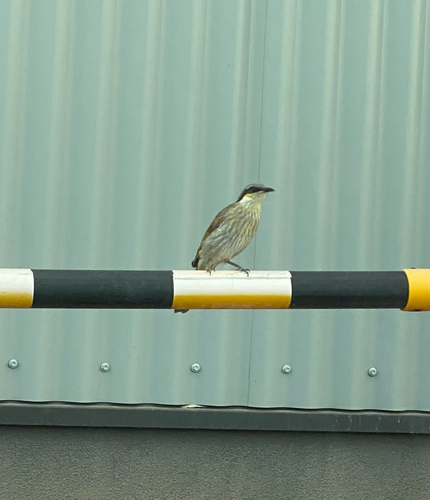
Singing Honeyeater
Gavicalis virescens
Singing honeyeaters can vary in length from 17–22 cm (6.7–8.7 in). Their overall appearance is grey-brown. The tail and wings are olive-green with flashes of yellow. There is a broad, black stripe running from the behind the beak to the back, and a yellow streak immediately below this from the eye. The bird's song ranges from scratchy to melodious. The song also varies according to where they live.
ID text from Wikipedia, CC BY-SA 4.0

Tui
Prosthemadera novaeseelandiae
The tūī is a large honeyeater, 27 to 32 cm (11–13 in) in length. The Chatham Islands subspecies is larger on average than the nominate subspecies, and heavier. Males tend to be heavier than females. Nominate males weigh between 65–150 g (2.3–5.3 oz), and females 58–105 g (2.0–3.7 oz). Males of the Chatham subspecies are 89–240 g (3.1–8.5 oz) and females 89–170 g (3.1–6.0 oz). At first glance the bird appears completely black except for a small tuft of white feathers at its neck and a small white wing patch, causing it to resemble a parson in clerical attire. Voice: Tūī are known for their noisy, unusual, sometimes soulful calls, different for each individual, that combine bellbird-like notes with clicks, cackles, timber-like creaks and groans, and wheezing sounds. Tūī have a complex variety of songs and calls, much like parrots.
ID text from Wikipedia, CC BY-SA 4.0

Learn this pair in the BeakBrain App
Photo and call practice. Coming soon to iPhone and Android.
Play today's Daily BirdPhotos and recordings are credited to their authors under the licence shown. Full profiles: Singing Honeyeater and Tui.