Learn what every symbol on the card means.Full credits and sources at beakbrain.com/symbols
 ShrublandCup nestSmall · 48 g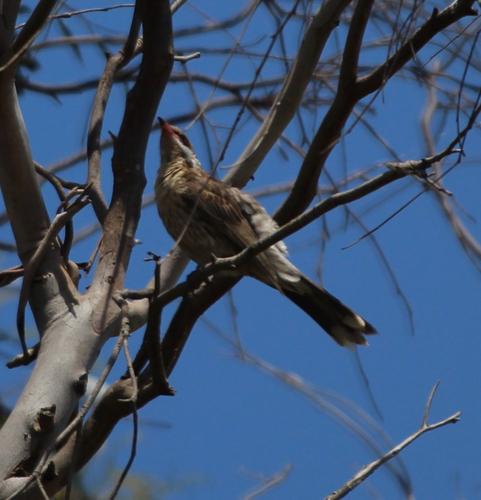


ID tip
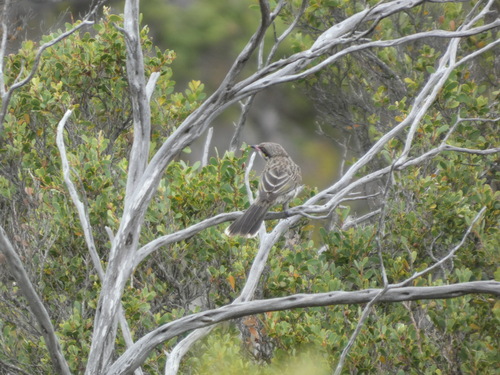
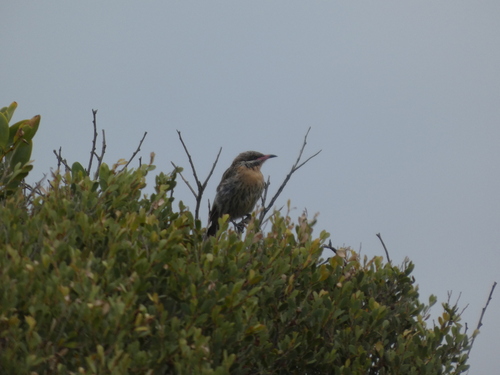
The spiny-cheeked honeyeater, Acanthagenys rufogularis, is a medium-sized bird, ranging from 22 to 27 centimeters (8.7 to 10.6 inches) in length. Its crown is speckled, dark grey on brown plumage. The juvenile bird has a characteristic yellow cheek sash, although this is less pronounced in the adult bird, where predominantly the cheek is white with a grey and/or brown streak under the cheek. Its beak is long and straight with a black tip and a fleshy red or pink colour towards the chin and up to the gape.
Text from Wikipedia, licensed CC BY-SA 4.0.
When to see the Spiny-cheeked Honeyeater
One bar for each month. Filled bars are the 11 months with records; pale bars are months with none. The wide bar is October, the month with the most records.
Where to see the Spiny-cheeked Honeyeater
The map shades 1 country with regular records. Everything unshaded has no records. Countries are listed below the map.
About the Spiny-cheeked Honeyeater
The spiny-cheeked honeyeater is the only species in the genus Acanthagenys. It is large for a honeyeater, ranging from 22 to 27 centimeters tall and weighing around 52 grams. The birds are sociable, aggressive, and often observed foraging in large flocks.
Text adapted from Wikipedia, licensed CC BY-SA 4.0.
Easily confused with
 White-eared HoneyeaterNesoptilotis leucotisThe white-eared honeyeater has an olive-green upper and lower body; its wings and tail are a mix of brown, yellow and olive; the crown is dark grey with black streaks; its cheeks and throat are black; its ear-coverts are white.
 Little FriarbirdPhilemon citreogularisThe little friarbird ranges from 25–30 centimetres (9.8–11.8 in) in length.
 New Zealand BellbirdAnthornis melanuraBellbirds are medium-sized honeyeaters, about 17–20 cm in length from the tip of their beak to the end of their tail.
Side by side: New Zealand Bellbird vs Spiny-cheeked Honeyeater · Spiny-cheeked Honeyeater vs White-eared Honeyeater · Little Friarbird vs Spiny-cheeked Honeyeater
Learn the Spiny-cheeked Honeyeater in the BeakBrain App
Photo and call practice. Coming soon to iPhone and Android.
Play today's Daily BirdEvery photo and recording on this page is credited to its author under the licence shown. Spotted a problem with this page, or have a better photo? Contribute.