
Little Friarbird
Philemon citreogularis
The little friarbird ranges from 25–30 centimetres (9.8–11.8 in) in length. The average size tends to be 27 centimetres (11 in) with an average weight of 67 grams (2.4 oz). Although males and females tend to be very similar in appearance, males are larger. The little friarbird can be easily distinguished from other friarbirds by the absence of a casque (a prominent ridge or bump present on the beak). Another key recognisable feature is the bare blue skin present under the eye which widens over the cheek. (The bare blue skin can vary from grey to black in tone. Voice: The little friarbird has a very distinct voice consisting of a repeated liquid mellow "gee-wit" or "chewip". When breeding, the song is extended and includes chattering scoldings. A common sequence may be paraphrased as "rackety-crookshank".
ID text from Wikipedia, CC BY-SA 4.0

Spiny-cheeked Honeyeater
Acanthagenys rufogularis
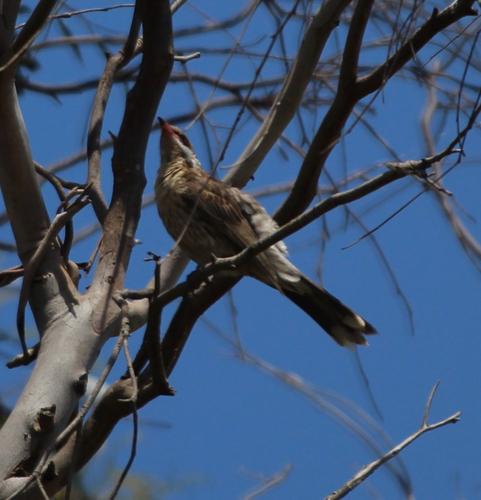
The spiny-cheeked honeyeater, Acanthagenys rufogularis, is a medium-sized bird, ranging from 22 to 27 centimeters (8.7 to 10.6 inches) in length. Its crown is speckled, dark grey on brown plumage. The juvenile bird has a characteristic yellow cheek sash, although this is less pronounced in the adult bird, where predominantly the cheek is white with a grey and/or brown streak under the cheek. Its beak is long and straight with a black tip and a fleshy red or pink colour towards the chin and up to the gape.
ID text from Wikipedia, CC BY-SA 4.0
Where you might meet both
Learn this pair in the BeakBrain App
Photo and call practice. Coming soon to iPhone and Android.
Play today's Daily BirdPhotos and recordings are credited to their authors under the licence shown. Full profiles: Little Friarbird and Spiny-cheeked Honeyeater.