Learn what every symbol on the card means.Full credits and sources at beakbrain.com/symbols
 ForestCup nestMedium · 61 g


What the Little Friarbird sounds like

ID tip
The little friarbird ranges from 25–30 centimetres (9.8–11.8 in) in length. The average size tends to be 27 centimetres (11 in) with an average weight of 67 grams (2.4 oz). Although males and females tend to be very similar in appearance, males are larger. The little friarbird can be easily distinguished from other friarbirds by the absence of a casque (a prominent ridge or bump present on the beak). Another key recognisable feature is the bare blue skin present under the eye which widens over the cheek. (The bare blue skin can vary from grey to black in tone. Voice: The little friarbird has a very distinct voice consisting of a repeated liquid mellow "gee-wit" or "chewip". When breeding, the song is extended and includes chattering scoldings. A common sequence may be paraphrased as "rackety-crookshank".
Text from Wikipedia, licensed CC BY-SA 4.0.
When to see the Little Friarbird
One bar for each month, and every month is filled: this bird is recorded here in all twelve. The wide bar is October, the month with the most records.
Where to see the Little Friarbird
The map shades 3 countries with regular records. Everything unshaded has no records. Countries are listed below the map.
About the Little Friarbird
The little friarbird, also known as the little leatherhead or yellow-throated friarbird, is the smallest of the friarbirds within the Philemon genus. It is found throughout northern and eastern Australia as well as southern Papua New Guinea. It lives a very prominent life, whereby it can easily be seen chasing other honeyeaters, and also it is very vocal. However, the little friarbird is usually spotted high up in trees, rarely being seen on the ground.
Text adapted from Wikipedia, licensed CC BY-SA 4.0.
Easily confused with
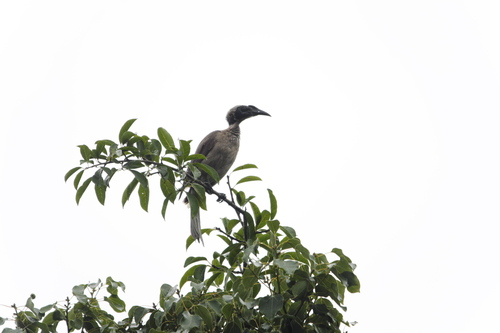 Helmeted FriarbirdPhilemon buceroidesThe helmeted friarbird has a dark gray face with red eyes.
 Noisy FriarbirdPhilemon corniculatusMeasuring 31–36 cm (12–14 in) in length, the noisy friarbird is a large honeyeater with dull brownish grey upperparts and paler brown-grey underparts.
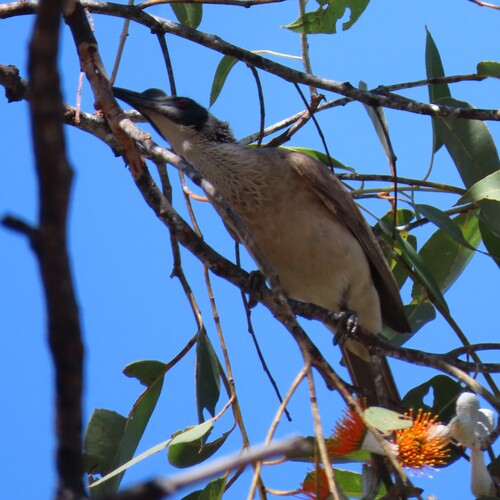 Silver-crowned FriarbirdPhilemon argenticepsThe silver-crowned friarbird is a species of bird in the family Meliphagidae.It is endemic to northern Australia, including Queensland.
Side by side: Little Friarbird vs Noisy Friarbird · Little Friarbird vs New Zealand Bellbird · Little Friarbird vs Spiny-cheeked Honeyeater · Helmeted Friarbird vs Little Friarbird
Learn the Little Friarbird in the BeakBrain App
Photo and call practice. Coming soon to iPhone and Android.
Play today's Daily BirdEvery photo and recording on this page is credited to its author under the licence shown. Spotted a problem with this page, or have a better photo? Contribute.