Learn what every symbol on the card means.Full credits and sources at beakbrain.com/symbols
 ForestCavity nestSmall · 27 g




What the New Zealand Bellbird sounds like


ID tip
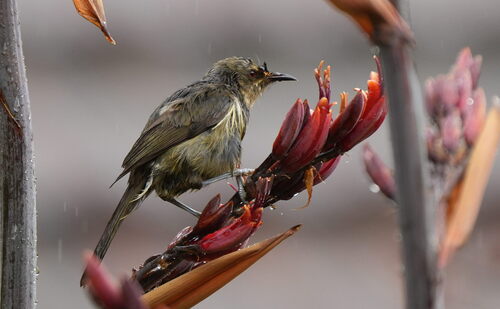
Bellbirds are medium-sized honeyeaters, about 17–20 cm in length from the tip of their beak to the end of their tail. Females weigh about 25 g and males 33 g. Males have an olive-green body with a dark purplish sheen on their head. Their belly and flanks are lighter. The uppertail is black-brown with a narrow iridescent blue-black edge on most feathers. The upperwing coverts are mostly dark olive-green, with blackish inner webs. The vent and undertail-coverts are pale yellow to off-white, and the thighs are grey.
Text from Wikipedia, licensed CC BY-SA 4.0.
When to see the New Zealand Bellbird
One bar for each month, and every month is filled: this bird is recorded here in all twelve. The wide bar is December, the month with the most records.
Where to see the New Zealand Bellbird
The map shades 1 country with regular records. Everything unshaded has no records. Countries are listed below the map.
About the New Zealand Bellbird
The New Zealand bellbird, also known by its Māori language names korimako, makomako and kōmako, is a medium-sized species of honeyeater endemic to New Zealand. It has been the only living member of the genus Anthornis since the Chatham Islands bellbird went extinct in the early 20th century. The bellbird's closest living relative is the only other New Zealand honeyeater, the tūī. The bellbird forms a significant component of the famed New Zealand dawn chorus of birdsong, which was much noted by early European settlers. Exceptional singing abilities were already observed by Captain James Cook, who described its song as "like small bells most exquisitely tuned".
Text adapted from Wikipedia, licensed CC BY-SA 4.0.
Easily confused with
 Little FriarbirdPhilemon citreogularisThe little friarbird ranges from 25–30 centimetres (9.8–11.8 in) in length.
 White-eared HoneyeaterNesoptilotis leucotisThe white-eared honeyeater has an olive-green upper and lower body; its wings and tail are a mix of brown, yellow and olive; the crown is dark grey with black streaks; its cheeks and throat are black; its ear-coverts are white.
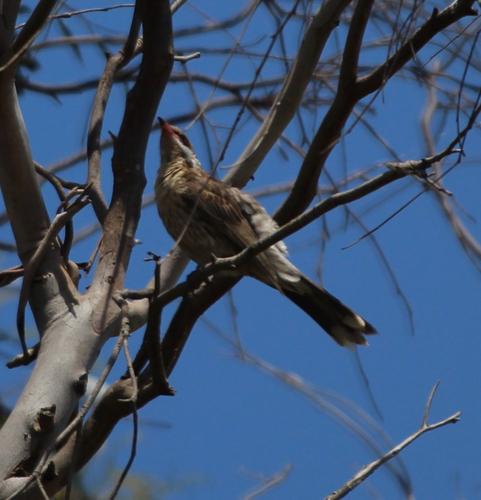 Spiny-cheeked HoneyeaterAcanthagenys rufogularisThe spiny-cheeked honeyeater, Acanthagenys rufogularis, is a medium-sized bird, ranging from 22 to 27 centimeters (8.7 to 10.6 inches) in length.
Side by side: Little Friarbird vs New Zealand Bellbird · New Zealand Bellbird vs White-eared Honeyeater · New Zealand Bellbird vs Spiny-cheeked Honeyeater
Learn the New Zealand Bellbird in the BeakBrain App
Photo and call practice. Coming soon to iPhone and Android.
Play today's Daily BirdEvery photo and recording on this page is credited to its author under the licence shown. Spotted a problem with this page, or have a better photo? Contribute.