Learn what every symbol on the card means.Full credits and sources at beakbrain.com/symbols
 WoodlandCup nestMedium · 64 g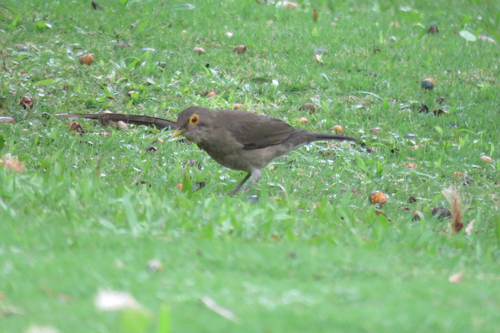


ID tip
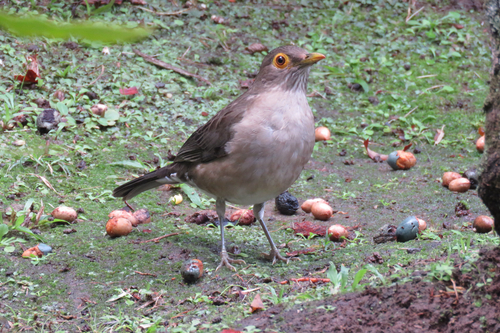
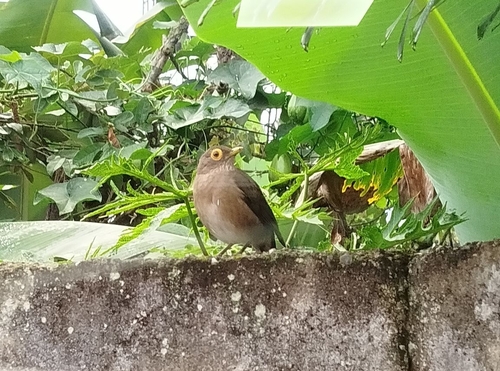
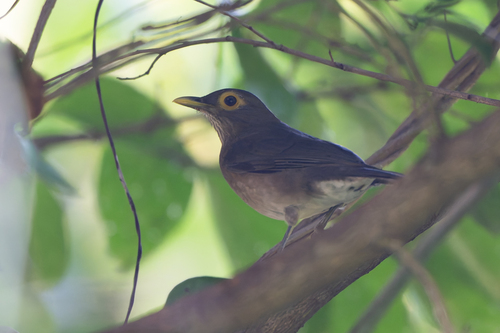
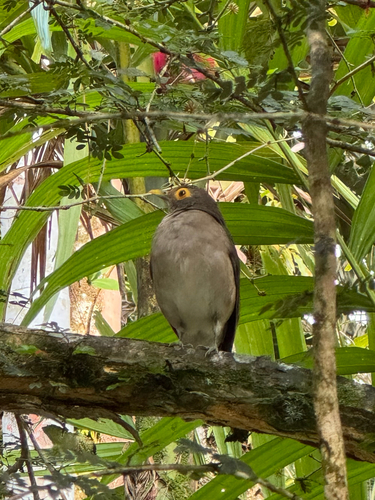
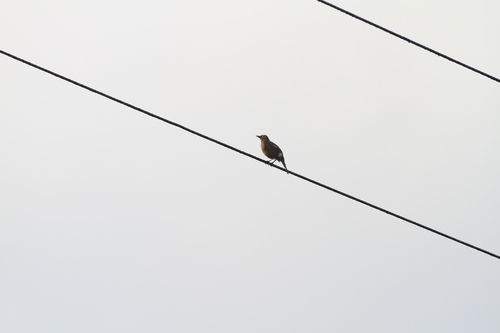
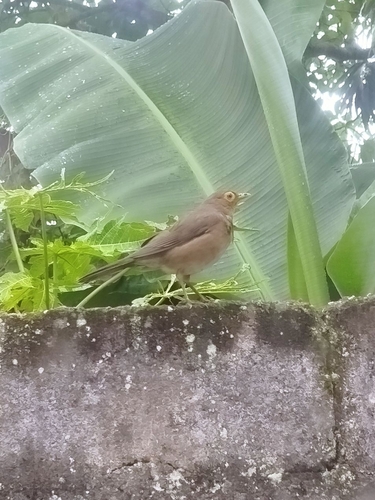
The spectacled thrush is 23–24 cm (9.1–9.4 in) long and weighs 60 g (2.1 oz). It is plain olive-brown above and paler brown below. The throat is brown-streaked off-white, and the lower belly is whitish. It has a prominent yellow eye ring which gives rise to its English and scientific names. There are two poorly defined subspecies, differing mainly in the darkness of the plumage. Sexes are similar, but young birds are flecked above and spotted below, and have a thinner eye ring. The song is a musical warble, slower and lower pitched than that of the cocoa thrush (T.
Text from Wikipedia, licensed CC BY-SA 4.0.
When to see the Spectacled Thrush
One bar for each month. Filled bars are the 11 months with records; pale bars are months with none. The wide bar is May, the month with the most records.
Where to see the Spectacled Thrush
The map shades 13 countries with regular records. Everything unshaded has no records. Countries are listed below the map.
About the Spectacled Thrush
The spectacled thrush, bare-eyed thrush, or yellow-eyed thrush, is a resident breeding bird in the Lesser Antilles and in South America from Colombia and Venezuela south and east to northern Brazil. In Trinidad and Tobago, this thrush is also known as big-eye grieve.
Text adapted from Wikipedia, licensed CC BY-SA 4.0.
Easily confused with
 Chinese BlackbirdTurdus mandarinusThe Chinese blackbird is a member of the thrush family Turdidae.
 White-throated ThrushTurdus assimilisThe white-throated thrush is 22 to 26.5 cm (8.7 to 10.4 in) long and weighs about 61 to 90 g (2.2 to 3.2 oz).
 Olive ThrushTurdus olivaceusIt can reach a length of 24 cm (9.4 in) and a weight of at least 101 g (3.6 oz).
Side by side: Olive Thrush vs Spectacled Thrush · Spectacled Thrush vs White-throated Thrush
Learn the Spectacled Thrush in the BeakBrain App
Photo and call practice. Coming soon to iPhone and Android.
Play today's Daily BirdEvery photo and recording on this page is credited to its author under the licence shown. Spotted a problem with this page, or have a better photo? Contribute.