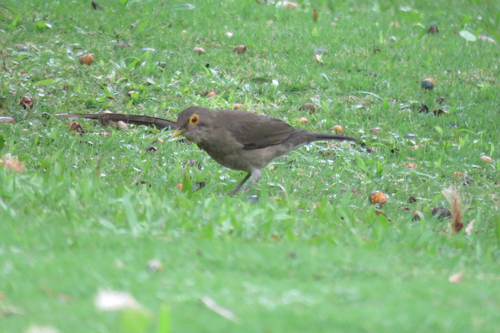
Spectacled Thrush
Turdus nudigenis
The spectacled thrush is 23–24 cm (9.1–9.4 in) long and weighs 60 g (2.1 oz). It is plain olive-brown above and paler brown below. The throat is brown-streaked off-white, and the lower belly is whitish. It has a prominent yellow eye ring which gives rise to its English and scientific names. There are two poorly defined subspecies, differing mainly in the darkness of the plumage. Sexes are similar, but young birds are flecked above and spotted below, and have a thinner eye ring. The song is a musical warble, slower and lower pitched than that of the cocoa thrush (T.
ID text from Wikipedia, CC BY-SA 4.0
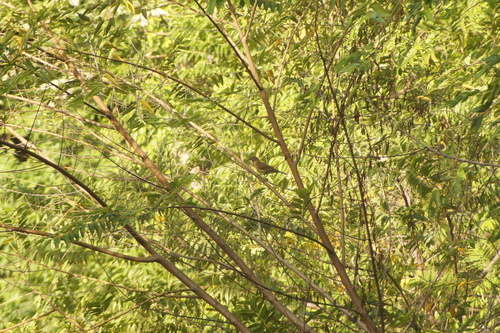
White-throated Thrush
Turdus assimilis
The white-throated thrush is 22 to 26.5 cm (8.7 to 10.4 in) long and weighs about 61 to 90 g (2.2 to 3.2 oz). The sexes have the same plumage. Adults of the nominate subspecies T. a. assimilis have a somewhat rusty brown head, upperparts, wings, tail. They have a yellow eye-ring. Their throat is white with dark brown streaks and a white crescent below it. Their breast is pale olive-brown that becomes whitish from the middle of the belly to the vent. Their undertail coverts are white. Voice: The white-throated thrush sings mostly between February and August and only seldom during the rest of the year. It sings throughout the morning and again in late afternoon, from a perch in the forest canopy. There is some variation among the subspecies' songs but in most cases they appear very similar; the variations have not been studied deeply. The outlier is T. a.
ID text from Wikipedia, CC BY-SA 4.0
Where you might meet both
Learn this pair in the BeakBrain App
Photo and call practice. Coming soon to iPhone and Android.
Play today's Daily BirdPhotos and recordings are credited to their authors under the licence shown. Full profiles: Spectacled Thrush and White-throated Thrush.