Learn what every symbol on the card means.Full credits and sources at beakbrain.com/symbols
 ForestCup nestMedium · 67 g


ID tip
It can reach a length of 24 cm (9.4 in) and a weight of at least 101 g (3.6 oz). The tail and the upperparts are coloured dull olive brown. The belly is white and the rest of the underparts have an orange hue. The throat is speckled with white spots. It can be found in evergreen forests, parks, and gardens. The male's song is a mix of fluted, whistled and trilled phrases, which varies geographically. It occasionally mimics other birds.
Text from Wikipedia, licensed CC BY-SA 4.0.
When to see the Olive Thrush
One bar for each month, and every month is filled: this bird is recorded here in all twelve. The wide bar is October, the month with the most records.
Where to see the Olive Thrush
The map shades 12 countries with regular records. Everything unshaded has no records. Countries are listed below the map.
About the Olive Thrush
The olive thrush is, in its range, one of the most common members of the thrush family (Turdidae). It occurs in African highlands from the montane regions in Eastern and Central Africa in the north to the Cape of Good Hope in the south. It is a bird of forest and woodland, but has locally adapted to parks and large gardens in suburban areas.
Text adapted from Wikipedia, licensed CC BY-SA 4.0.
Easily confused with
 Chinese BlackbirdTurdus mandarinusThe Chinese blackbird is a member of the thrush family Turdidae.
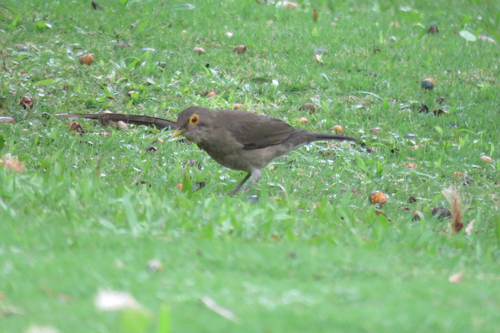 Spectacled ThrushTurdus nudigenisThe spectacled thrush is 23–24 cm (9.1–9.4 in) long and weighs 60 g (2.1 oz).
 Pale ThrushTurdus pallidusIt is 23 cm long.
Side by side: Olive Thrush vs Pale Thrush · Olive Thrush vs Spectacled Thrush
Learn the Olive Thrush in the BeakBrain App
Photo and call practice. Coming soon to iPhone and Android.
Play today's Daily BirdEvery photo and recording on this page is credited to its author under the licence shown. Spotted a problem with this page, or have a better photo? Contribute.