
Olive Thrush
Turdus olivaceus
It can reach a length of 24 cm (9.4 in) and a weight of at least 101 g (3.6 oz). The tail and the upperparts are coloured dull olive brown. The belly is white and the rest of the underparts have an orange hue. The throat is speckled with white spots. It can be found in evergreen forests, parks, and gardens. The male's song is a mix of fluted, whistled and trilled phrases, which varies geographically. It occasionally mimics other birds.
ID text from Wikipedia, CC BY-SA 4.0
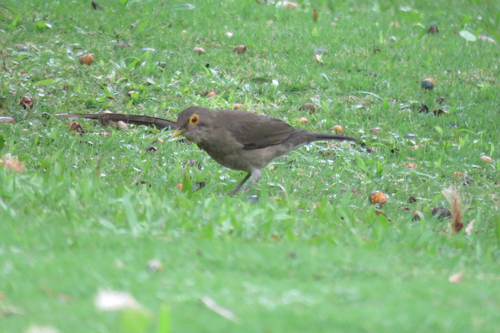
Spectacled Thrush
Turdus nudigenis
The spectacled thrush is 23–24 cm (9.1–9.4 in) long and weighs 60 g (2.1 oz). It is plain olive-brown above and paler brown below. The throat is brown-streaked off-white, and the lower belly is whitish. It has a prominent yellow eye ring which gives rise to its English and scientific names. There are two poorly defined subspecies, differing mainly in the darkness of the plumage. Sexes are similar, but young birds are flecked above and spotted below, and have a thinner eye ring. The song is a musical warble, slower and lower pitched than that of the cocoa thrush (T.
ID text from Wikipedia, CC BY-SA 4.0
Learn this pair in the BeakBrain App
Photo and call practice. Coming soon to iPhone and Android.
Play today's Daily BirdPhotos and recordings are credited to their authors under the licence shown. Full profiles: Olive Thrush and Spectacled Thrush.