Learn what every symbol on the card means.Full credits and sources at beakbrain.com/symbols
 WetlandPlatform nestHuge · 5.9 kg


ID tip
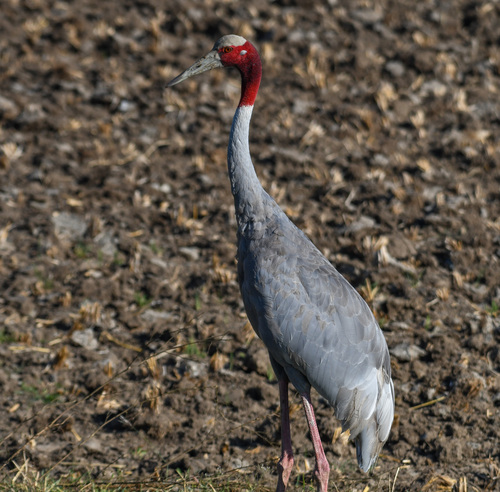
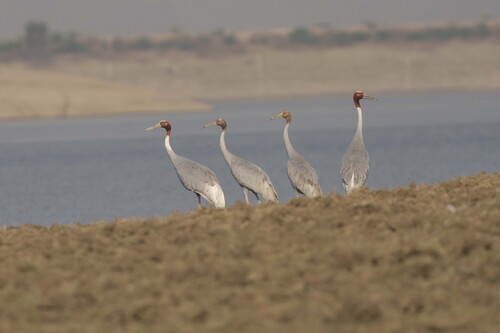
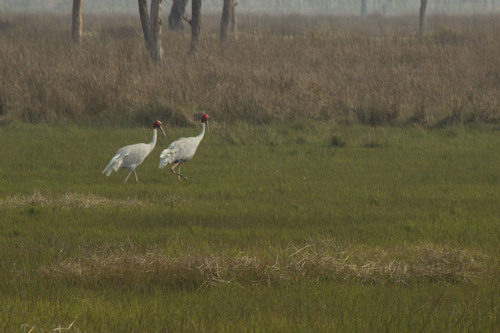
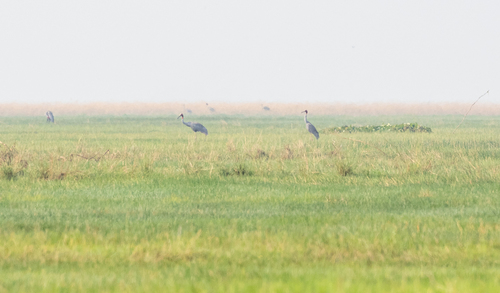
The adult sarus crane is very large, with grey wings and body, a bare red head, collar and nape, a greyish crown, and a long, greenish-grey, pointed bill. In flight, the long neck is held straight, unlike that of a heron (which folds it back), and the black wing tips can be seen; the crane's long, pink legs trail behind them. This bird has a grey ear covert patch, orange-red irises, and a greenish-grey bill. Juveniles have a yellowish base to the bill and the brown-grey head is fully feathered. The bare red skin of the adult's head and neck is brighter during the breeding season.
Text from Wikipedia, licensed CC BY-SA 4.0.
When to see the Sarus Crane
One bar for each month. Filled bars are the 11 months with records; pale bars are months with none. The wide bar is February, the month with the most records.
Where to see the Sarus Crane
The map shades 7 countries with regular records, and 1 more in a lighter tone where the bird turns up only as a stray. Everything unshaded has no records. Countries are listed below the map.
Recorded as a rare visitor in United States.
About the Sarus Crane
The sarus crane is a large nonmigratory crane found in parts of the Indian subcontinent, Southeast Asia, and northern Australia. The tallest of the flying birds, standing at a height of up to 1.8 m, they are a conspicuous species of open wetlands in South Asia, seasonally flooded Dipterocarpus forests in Southeast Asia, and Eucalyptus-dominated woodlands and grasslands in Australia.
Text adapted from Wikipedia, licensed CC BY-SA 4.0.
Easily confused with
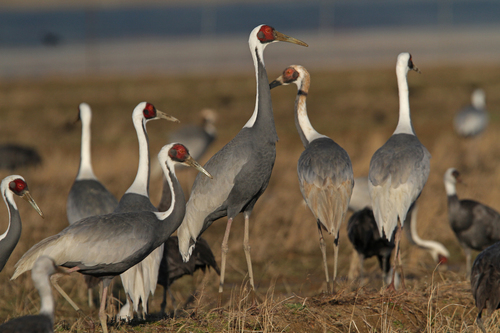 White-naped CraneAntigone vipioThe white-naped crane can be identified by its grey body, reddish face patch, white throat, and the white strip going from the back of its crown down its neck, or nape.
 BrolgaAntigone rubicundaThe brolga is a tall bird with a large beak, a long and slender neck, and stilt-like legs.
 Sandhill CraneAntigone canadensisAdults are gray overall; during breeding, their plumage is usually much worn and stained, particularly in the migratory populations, and looks nearly ochre.
Side by side: Sandhill Crane vs Sarus Crane · Brolga vs Sarus Crane · Sarus Crane vs White-naped Crane
Learn the Sarus Crane in the BeakBrain App
Photo and call practice. Coming soon to iPhone and Android.
Play today's Daily BirdEvery photo and recording on this page is credited to its author under the licence shown. Spotted a problem with this page, or have a better photo? Contribute.