Learn what every symbol on the card means.Full credits and sources at beakbrain.com/symbols
 WetlandPlatform nestHuge · 4.3 kg


What the Sandhill Crane sounds like


ID tip
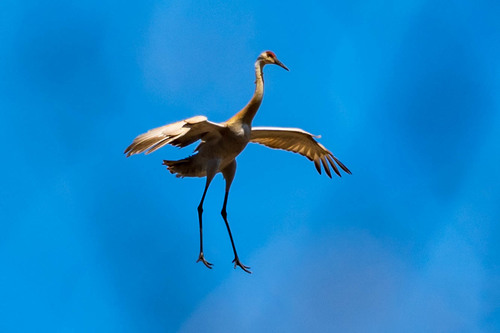
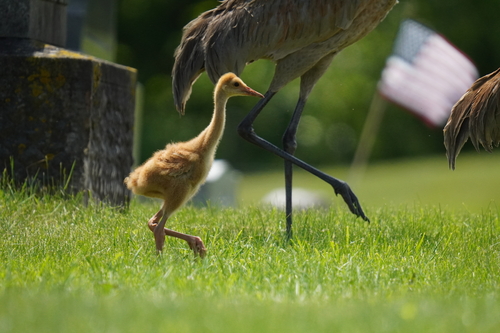
Adults are gray overall; during breeding, their plumage is usually much worn and stained, particularly in the migratory populations, and looks nearly ochre. The average weight of the larger males is 4.57 kg (10.1 lb), while the average weight of females is 4.02 kg (8.9 lb), with a range of 2.7 to 6.7 kg (6.0 to 14.8 lb) across the subspecies. Sandhill cranes have red foreheads, white cheeks, and long, dark, pointed bills. In flight, their long, dark legs trail behind, and their long necks keep straight. Immature birds have reddish-brown upper parts and gray underparts.
Text from Wikipedia, licensed CC BY-SA 4.0.
When to see the Sandhill Crane
One bar for each month, and every month is filled: this bird is recorded here in all twelve. The wide bar is May, the month with the most records.
Where to see the Sandhill Crane
The map shades 16 countries with regular records, and 6 more in a lighter tone where the bird turns up only as a stray. Everything unshaded has no records. Countries are listed below the map.
Recorded as a rare visitor in United Kingdom, Taiwan, Finland, Spain, St. Pierre & Miquelon, Lithuania.
About the Sandhill Crane
The sandhill crane is a species of large crane of North America and extreme northeastern Siberia. The common name of this bird refers to its habitat, such as the Platte River, on the edge of Nebraska's Sandhills on the American Great Plains. Sandhill cranes are known to frequent the edges of bodies of water. The central Platte River Valley in Nebraska is the most important stopover area for the nominotypical subspecies, the lesser sandhill crane (A. c. canadensis), with up to 450,000 of these birds migrating through annually.
Text adapted from Wikipedia, licensed CC BY-SA 4.0.
Easily confused with
 BrolgaAntigone rubicundaThe brolga is a tall bird with a large beak, a long and slender neck, and stilt-like legs.
 Sarus CraneAntigone antigoneThe adult sarus crane is very large, with grey wings and body, a bare red head, collar and nape, a greyish crown, and a long, greenish-grey, pointed bill.
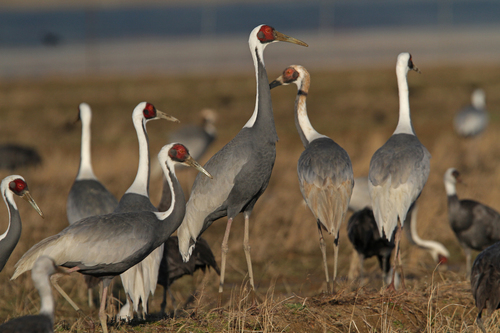 White-naped CraneAntigone vipioThe white-naped crane can be identified by its grey body, reddish face patch, white throat, and the white strip going from the back of its crown down its neck, or nape.
Side by side: Brolga vs Sandhill Crane · Sandhill Crane vs Sarus Crane · Sandhill Crane vs White-naped Crane
Learn the Sandhill Crane in the BeakBrain App
Photo and call practice. Coming soon to iPhone and Android.
Play today's Daily BirdEvery photo and recording on this page is credited to its author under the licence shown. Spotted a problem with this page, or have a better photo? Contribute.