
Sarus Crane
Antigone antigone
The adult sarus crane is very large, with grey wings and body, a bare red head, collar and nape, a greyish crown, and a long, greenish-grey, pointed bill. In flight, the long neck is held straight, unlike that of a heron (which folds it back), and the black wing tips can be seen; the crane's long, pink legs trail behind them. This bird has a grey ear covert patch, orange-red irises, and a greenish-grey bill. Juveniles have a yellowish base to the bill and the brown-grey head is fully feathered. The bare red skin of the adult's head and neck is brighter during the breeding season.
ID text from Wikipedia, CC BY-SA 4.0
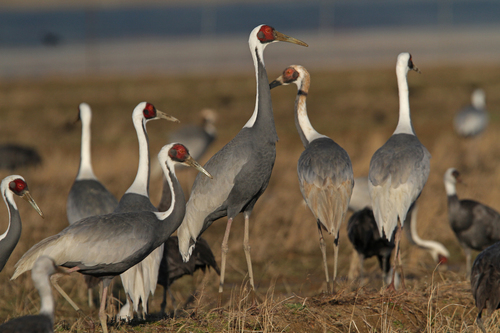
White-naped Crane
Antigone vipio
The white-naped crane can be identified by its grey body, reddish face patch, white throat, and the white strip going from the back of its crown down its neck, or nape. Juveniles differ by having a brown head and a pale throat. While this crane does have other species in its genus with similar characteristics, it can be distinguished by the white nape that is not present in the other species. The white-naped crane emits a variety of different calls: a growling contact call, or high pitched call at short ranges, and loud calls which differ between sexes.
ID text from Wikipedia, CC BY-SA 4.0

Learn this pair in the BeakBrain App
Photo and call practice. Coming soon to iPhone and Android.
Play today's Daily BirdPhotos and recordings are credited to their authors under the licence shown. Full profiles: Sarus Crane and White-naped Crane.