Learn what every symbol on the card means.Full credits and sources at beakbrain.com/symbols
 ShrublandCup nestSmall · 20 g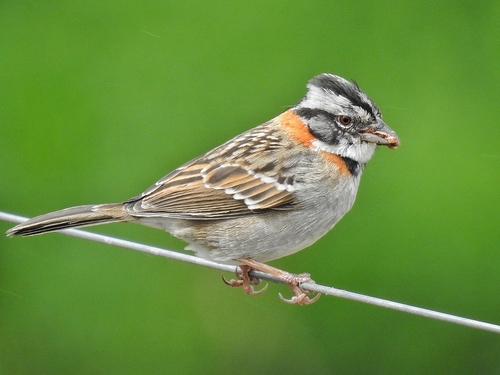


What the Rufous-collared Sparrow sounds like


ID tip
The rufous-collared sparrow is 13.5–15 cm (5+1⁄4–6 in) long and weighs 20–25 g (0.71–0.88 oz). The adult has a stubby grey bill, and a grey head with broad black stripes on the crown sides, and thinner stripes through the eye and below the cheeks. The nape and breast sides are rufous, and the upperparts are black-streaked buff-brown. There are two white wing bars. The throat is white, and the underparts are off-white, becoming brown on the flanks and with a black breast patch. Young birds have a duller, indistinct head pattern, with brown stripes and a buff ground colour. Voice: The rufous-collared sparrow has extensive geographical variation in its vocalisations, but calls include a sharp tsip. The male's song, given from a low perch, typically includes slurred whistles with or without a final trill, tee-teeooo, e'e'e'e'e, or teeooo, teeeee.
Text from Wikipedia, licensed CC BY-SA 4.0.
When to see the Rufous-collared Sparrow
One bar for each month, and every month is filled: this bird is recorded here in all twelve. The wide bar is October, the month with the most records.
Where to see the Rufous-collared Sparrow
The map shades 25 countries with regular records, and 1 more in a lighter tone where the bird turns up only as a stray. Everything unshaded has no records. Countries are listed below the map.
Recorded as a rare visitor in United States.
About the Rufous-collared Sparrow
The rufous-collared sparrow or Andean sparrow is an American sparrow found in a wide range of habitats, often near humans, from the extreme south-east of Mexico to Tierra del Fuego, and the island of Hispaniola in the Caribbean. It has diverse vocalizations, which have been intensely studied since the 1970s, particularly by Paul Handford and Stephen C. Lougheed (UWO), Fernando Nottebohm and Pablo Luis Tubaro (UBA). Local names for this bird include the Portuguese tico-tico and mariquinha, the Aymara Pichitanka the Spanish copetón ("tufted") in Colombia, as well as chingolo and chincol, comemaíz "corn eater" in Costa Rica, chincol in Chile and Cigua de Constanza in the Dominican Republic.
Text adapted from Wikipedia, licensed CC BY-SA 4.0.
Easily confused with
 Golden-crowned SparrowZonotrichia atricapillaMeasuring 15–18 cm (6–7 in) in length with a wingspan of 24.75 cm (9.74 in) and ranging from 19.0 to 35.4 g (0.67 to 1.25 oz) in mass, the adult golden-crowned sparrow is fairly large for an American sparrow.
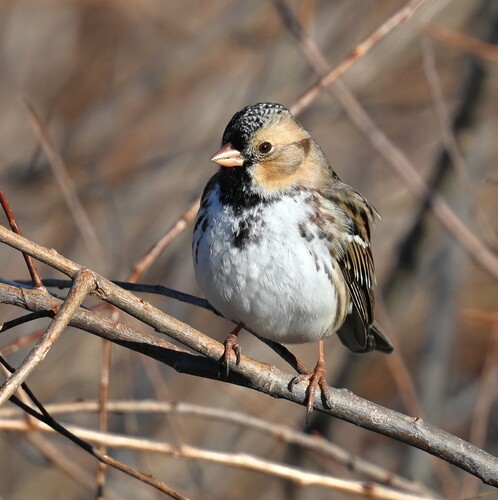 Harris's SparrowZonotrichia querulaThis species is the largest of the sparrows in the family Passerellidae, though other superficially dissimilar species in the family may slightly exceed them in size.
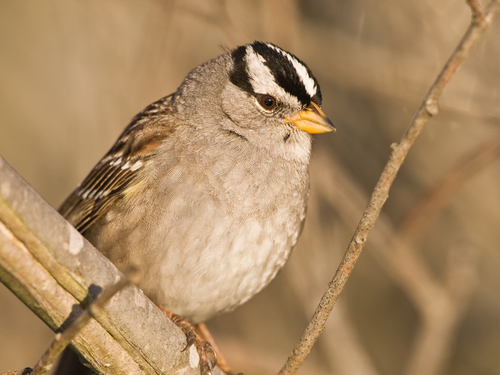 White-crowned SparrowZonotrichia leucophrysAdults have black and white stripes on their head, a gray face, brown streaked upper parts and a long tail.
Side by side: Rufous-collared Sparrow vs White-throated Sparrow · Rufous-collared Sparrow vs White-crowned Sparrow · Golden-crowned Sparrow vs Rufous-collared Sparrow · Lark Sparrow vs Rufous-collared Sparrow · Harris's Sparrow vs Rufous-collared Sparrow
Learn the Rufous-collared Sparrow in the BeakBrain App
Photo and call practice. Coming soon to iPhone and Android.
Play today's Daily BirdEvery photo and recording on this page is credited to its author under the licence shown. Spotted a problem with this page, or have a better photo? Contribute.