Learn what every symbol on the card means.Full credits and sources at beakbrain.com/symbols
 ShrublandCup nestSmall · 36 g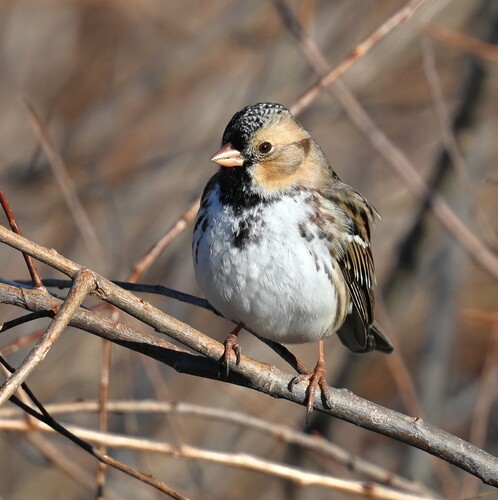


What the Harris's Sparrow sounds like


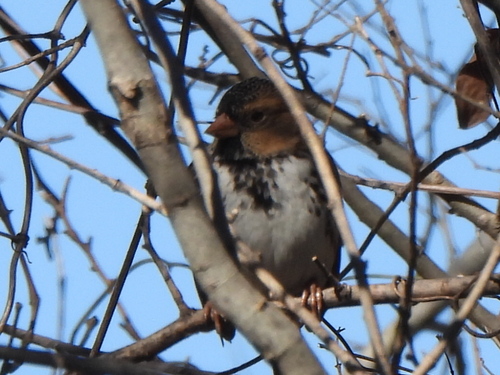
ID tip
This species is the largest of the sparrows in the family Passerellidae, though other superficially dissimilar species in the family may slightly exceed them in size. They range in total length from 17 to 20 cm (6.7 to 7.9 in), with a 27 cm (11 in) wingspan and weigh from 26 to 49 g (0.92 to 1.73 oz). Among standard measurements, the wing chord is 7.7 to 9.2 cm (3.0 to 3.6 in), the tail is 7.6 to 8.8 cm (3.0 to 3.5 in), the bill is 1.1 to 1.4 cm (0.43 to 0.55 in) and the tarsus is 2.2 to 2.5 cm (0.87 to 0.98 in). This is a very distinctive looking species.
Text from Wikipedia, licensed CC BY-SA 4.0.
When to see the Harris's Sparrow
One bar for each month. Filled bars are the 8 months with records; pale bars are months with none. The wide bar is January, the month with the most records.
Where to see the Harris's Sparrow
The map shades 2 countries with regular records, and 1 more in a lighter tone where the bird turns up only as a stray. Everything unshaded has no records. Countries are listed below the map.
Recorded as a rare visitor in Mexico.
About the Harris's Sparrow
Harris's sparrow is a large sparrow. Their breeding habitat is the north part of central Canada, making it Canada's only endemic breeding bird. In the winter they migrate to the Great Plains states of the United States, from southern South Dakota to central Texas. The common name of this species commemorates the American amateur ornithologist Edward Harris (1799–1863).
Text adapted from Wikipedia, licensed CC BY-SA 4.0.
Easily confused with
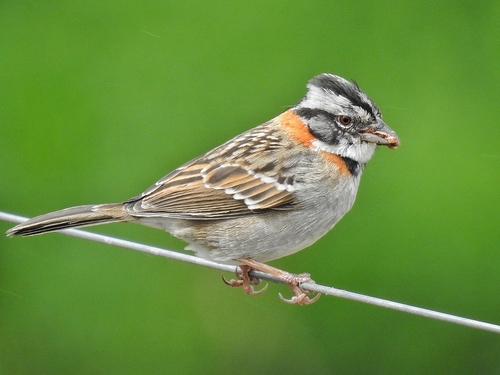 Rufous-collared SparrowZonotrichia capensisThe rufous-collared sparrow is 13.5–15 cm (5+1⁄4–6 in) long and weighs 20–25 g (0.71–0.88 oz).
 Golden-crowned SparrowZonotrichia atricapillaMeasuring 15–18 cm (6–7 in) in length with a wingspan of 24.75 cm (9.74 in) and ranging from 19.0 to 35.4 g (0.67 to 1.25 oz) in mass, the adult golden-crowned sparrow is fairly large for an American sparrow.
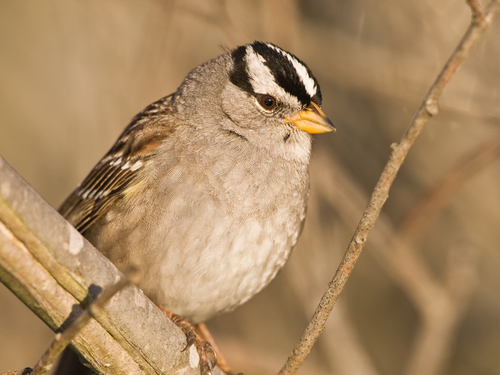 White-crowned SparrowZonotrichia leucophrysAdults have black and white stripes on their head, a gray face, brown streaked upper parts and a long tail.
Side by side: Golden-crowned Sparrow vs Harris's Sparrow · Harris's Sparrow vs Rufous-collared Sparrow · Harris's Sparrow vs White-crowned Sparrow
Learn the Harris's Sparrow in the BeakBrain App
Photo and call practice. Coming soon to iPhone and Android.
Play today's Daily BirdEvery photo and recording on this page is credited to its author under the licence shown. Spotted a problem with this page, or have a better photo? Contribute.