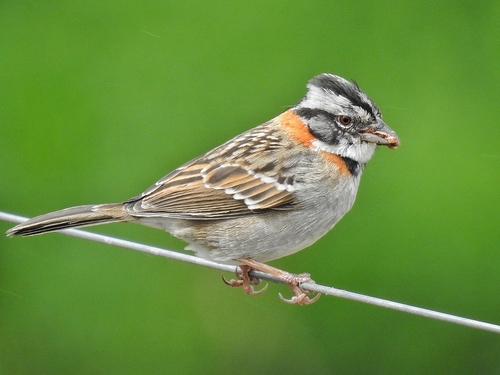
Rufous-collared Sparrow
Zonotrichia capensis
The rufous-collared sparrow is 13.5–15 cm (5+1⁄4–6 in) long and weighs 20–25 g (0.71–0.88 oz). The adult has a stubby grey bill, and a grey head with broad black stripes on the crown sides, and thinner stripes through the eye and below the cheeks. The nape and breast sides are rufous, and the upperparts are black-streaked buff-brown. There are two white wing bars. The throat is white, and the underparts are off-white, becoming brown on the flanks and with a black breast patch. Young birds have a duller, indistinct head pattern, with brown stripes and a buff ground colour. Voice: The rufous-collared sparrow has extensive geographical variation in its vocalisations, but calls include a sharp tsip. The male's song, given from a low perch, typically includes slurred whistles with or without a final trill, tee-teeooo, e'e'e'e'e, or teeooo, teeeee.
ID text from Wikipedia, CC BY-SA 4.0

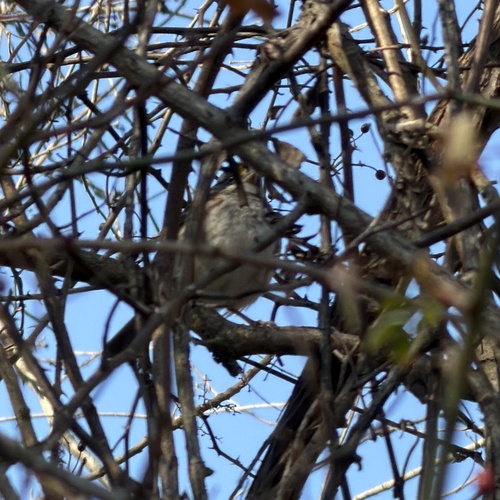
White-throated Sparrow
Zonotrichia albicollis
The white-throated sparrow is a passerine bird of the New World sparrow family Passerellidae. It measures 15 to 19 cm (5.9 to 7.5 in) in length with a wingspan of 23 cm (9.1 in). Typical weight is 22 to 32 g (0.78 to 1.13 oz), with an average of 26 g (0.92 oz). Among standard measurements, the wing chord is 6.3 to 7.9 cm (2.5 to 3.1 in), the tail is 6.8 to 7.7 cm (2.7 to 3.0 in), the bill is 1 to 1.2 cm (0.39 to 0.47 in) and the tarsus is 2.2 to 2.4 cm (0.87 to 0.94 in). They are similar in appearance to the white-crowned sparrow, but with white throat markings and yellow lores. Voice: White-throated sparrows produce song laterally through the left side of their syrinx, and control of their syrinx involves both their central and peripheral nervous systems. After damage to motor control of the left side of the syrinx, individuals were still able to produce sound but their song pattern was distorted, indicating the left side chiefly controls their production of song.
ID text from Wikipedia, CC BY-SA 4.0

Where you might meet both
Learn this pair in the BeakBrain App
Photo and call practice. Coming soon to iPhone and Android.
Play today's Daily BirdPhotos and recordings are credited to their authors under the licence shown. Full profiles: Rufous-collared Sparrow and White-throated Sparrow.