Learn what every symbol on the card means.Full credits and sources at beakbrain.com/symbols
 WetlandPlatform nestLarge · 1.0 kg



What the Red-breasted Merganser sounds like


ID tip
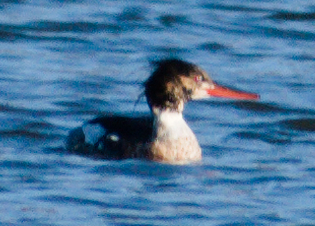
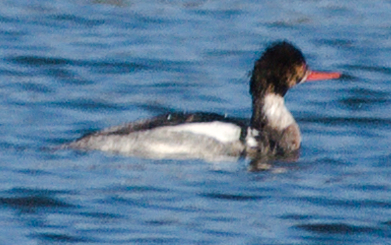
The adult red-breasted merganser is 51–64 cm (20–25 in) long, has a wingspan of 66–74 cm (26–29 in). Males average slightly larger, weighing 950–1,350 g (34–48 oz), compared to female weight of 800–1,100 g (28–39 oz). It has a spiky crest and long thin red bill with serrated edges. The male has a dark head with a green sheen, a white neck with a rusty breast, a black back, and white underparts. Adult females have a rusty head and a greyish-brown body. Juveniles look similar to females, but have a shorter crest, and marginally smaller white wing patches. Voice: During courtship, the female gives a rasping prrak prrak, while the male gives a catlike meow. In flight, the female makes a harsh gruk. At other times this species is largely silent.
Text from Wikipedia, licensed CC BY-SA 4.0.
When to see the Red-breasted Merganser
One bar for each month. Filled bars are the 9 months with records; pale bars are months with none. The wide bar is April, the month with the most records.
Where to see the Red-breasted Merganser
The map shades 71 countries with regular records, and 13 more in a lighter tone where the bird turns up only as a stray. Everything unshaded has no records. Countries are listed below the map.
Recorded as a rare visitor in India, Costa Rica, Panama, Morocco, Luxembourg, Egypt, Libya, Oman, Turkmenistan, Vietnam, Dominican Republic, Turks & Caicos Islands, Bosnia & Herzegovina.
About the Red-breasted Merganser
The red-breasted merganser is a duck species that is native to much of the temperate to subarctic Northern Hemisphere. The red breast that gives the species its common name is only displayed by males in breeding plumage. Individuals fly rapidly, and feed by diving from the surface to pursue aquatic animals underwater, using serrated bills to capture slippery fish. They migrate each year from breeding sites on lakes and rivers to their mostly coastal wintering areas, making them the most frequent species in the genus Mergus to frequent saltwater regularly. The worldwide population of this species is stable, though it is threatened in some areas by habitat loss and other factors.
Text adapted from Wikipedia, licensed CC BY-SA 4.0.
Easily confused with
 Common MerganserMergus merganserIt is 58–72 cm (23–28+1⁄2 in) long with a 78–97 cm (30+1⁄2–38 in) wingspan and a weight of 0.9–2.1 kg (2 lb 0 oz – 4 lb 10 oz); males are on average slightly larger than females, but with some overlap.
 Scaly-sided MerganserMergus squamatusThis striking sea duck has a thin red bill and a scaled dark pattern on the flanks and rump.
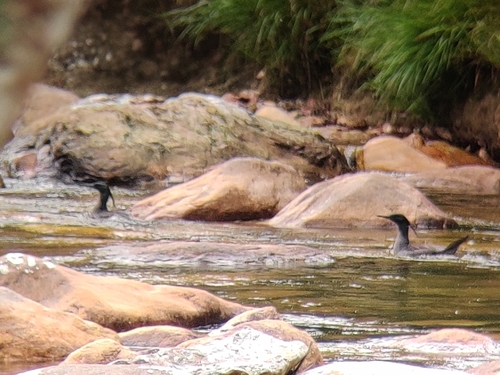 Brazilian MerganserMergus octosetaceusThis merganser is a dark, slender duck with a shiny dark-green hood with a long crest, which is usually shorter and more worn-looking in females.
Side by side: Common Merganser vs Red-breasted Merganser
Learn the Red-breasted Merganser in the BeakBrain App
Photo and call practice. Coming soon to iPhone and Android.
Play today's Daily BirdEvery photo and recording on this page is credited to its author under the licence shown. Spotted a problem with this page, or have a better photo? Contribute.