Learn what every symbol on the card means.Full credits and sources at beakbrain.com/symbols
 RiverineCavity nestLarge · 1.5 kg



What the Common Merganser sounds like

ID tip
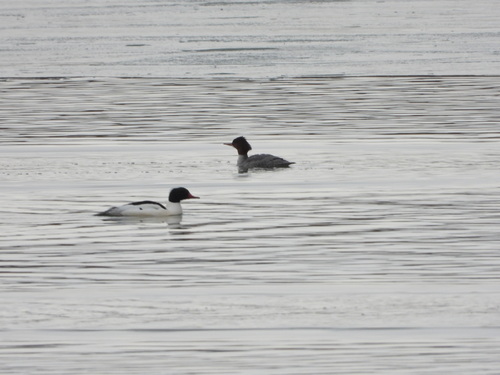
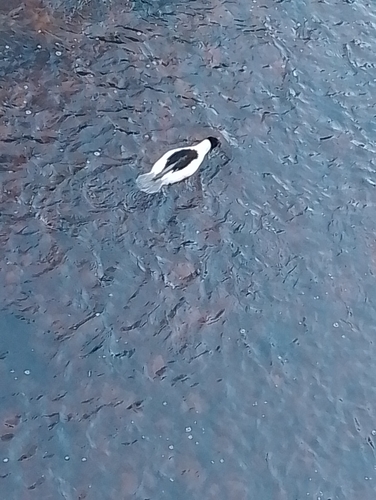
It is 58–72 cm (23–28+1⁄2 in) long with a 78–97 cm (30+1⁄2–38 in) wingspan and a weight of 0.9–2.1 kg (2 lb 0 oz – 4 lb 10 oz); males are on average slightly larger than females, but with some overlap. Like other species in the genus Mergus, it has a crest of longer head feathers, but these usually lie smoothly rounded behind the head and do not normally form an erect crest.
Text from Wikipedia, licensed CC BY-SA 4.0.
When to see the Common Merganser
One bar for each month. Filled bars are the 9 months with records; pale bars are months with none. The wide bar is March, the month with the most records.
Where to see the Common Merganser
The map shades 67 countries with regular records, and 2 more in a lighter tone where the bird turns up only as a stray. Everything unshaded has no records. Countries are listed below the map.
About the Common Merganser
The common merganser or goosander is a large sea duck of rivers and lakes in forested areas of Europe, Asia, and North America. The common merganser eats mainly fish. It nests in holes in trees. The name "common merganser" is used in North America, while "goosander" is used in Eurasia.
Text adapted from Wikipedia, licensed CC BY-SA 4.0.
Easily confused with
 Red-breasted MerganserMergus serratorThe adult red-breasted merganser is 51–64 cm (20–25 in) long, has a wingspan of 66–74 cm (26–29 in).
 Scaly-sided MerganserMergus squamatusThis striking sea duck has a thin red bill and a scaled dark pattern on the flanks and rump.
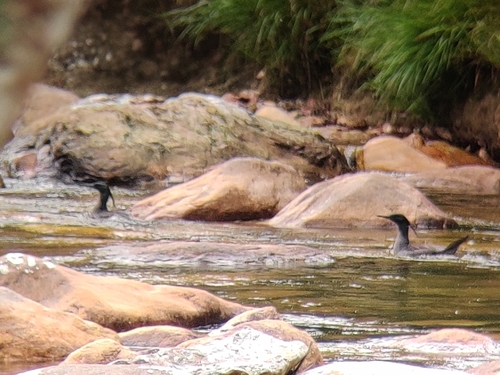 Brazilian MerganserMergus octosetaceusThis merganser is a dark, slender duck with a shiny dark-green hood with a long crest, which is usually shorter and more worn-looking in females.
Side by side: Common Merganser vs Red-breasted Merganser
Learn the Common Merganser in the BeakBrain App
Photo and call practice. Coming soon to iPhone and Android.
Play today's Daily BirdEvery photo and recording on this page is credited to its author under the licence shown. Spotted a problem with this page, or have a better photo? Contribute.