Learn what every symbol on the card means.Full credits and sources at beakbrain.com/symbols
 WoodlandCup nestMedium · 128 g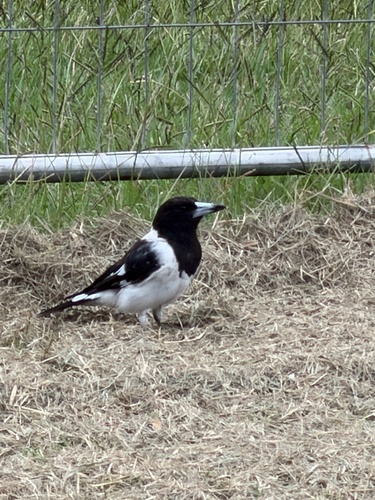


What the Pied Butcherbird sounds like

ID tip
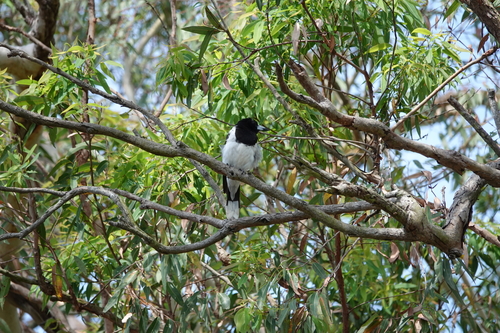
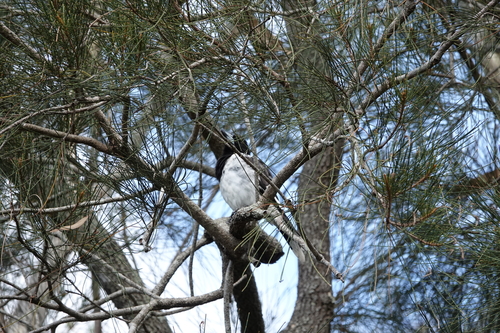
Like other butcherbirds, the pied butcherbird is stockily built with short legs and a relatively large head. It ranges from 28 to 32 cm (11 to 12.5 in) long, averaging around 31 cm (12 in), with a 51 cm (20 in) wingspan and a weight of around 120 g (4 oz). The wings are fairly long, extending to halfway along the tail when folded. Its plumage is almost wholly black and white, with very little difference between the sexes. It has a black head, nape, and throat, giving it the appearance of a black hood, which is bounded by a white neck collar, which is around 3.2 cm (1.2 in) wide. Voice: The pied butcherbird has been considered the most accomplished songbird in Australia, its song described as a "magic flute" by one writer, richer and clearer than the Australian magpie. Song melodies vary across the continent, and no single song is sung by the whole population. There is no clear demarcation between simple calls and elaborate songs: duets and even larger choirs are common.
Text from Wikipedia, licensed CC BY-SA 4.0.
When to see the Pied Butcherbird
One bar for each month, and every month is filled: this bird is recorded here in all twelve. The wide bar is July, the month with the most records.
Where to see the Pied Butcherbird
The map shades 1 country with regular records. Everything unshaded has no records. Countries are listed below the map.
About the Pied Butcherbird
The pied butcherbird is a songbird native to Australia. Initially described by John Gould in 1837, it is a black-and-white bird 28 to 32 cm long with a long, hooked bill. Its head and throat are black, making a distinctive hood; the mantle and much of the tail and wings are also black. The neck, underparts, and outer wing feathers are white. The juvenile and immature birds are predominantly brown and white. As they mature, black feathers replace their brown feathers. There are two recognised subspecies of pied butcherbird.
Text adapted from Wikipedia, licensed CC BY-SA 4.0.
Easily confused with
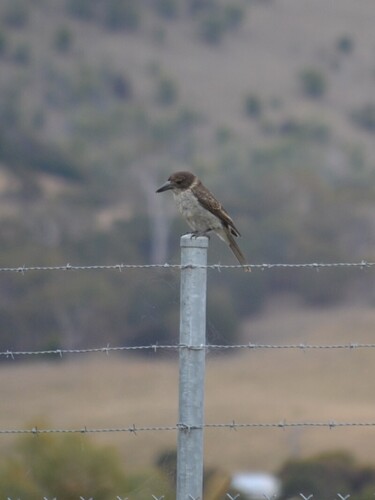 Grey ButcherbirdCracticus torquatusThe grey butcherbird is a small grey, black and white bird with a weight of 90 grams (3.2 ounces), a body length between 27 and 30 cm (11 and 12 in) and a wing span expanding 37–43 cm (15–17 in).
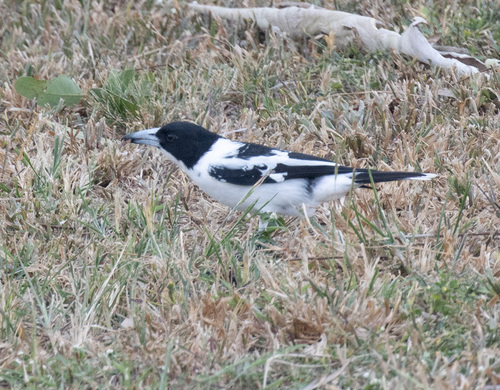 Black-backed ButcherbirdCracticus mentalisLike other butcherbirds, the black-backed butcherbird is a stockily built bird with a relatively large head and short wings and legs.
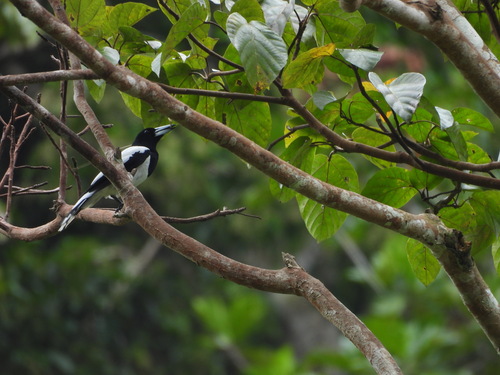 Hooded ButcherbirdCracticus cassicusMeasuring 32–35 cm in length, the male and female are similar in appearance.
Side by side: Australian Magpie vs Pied Butcherbird · Grey Butcherbird vs Pied Butcherbird
Learn the Pied Butcherbird in the BeakBrain App
Photo and call practice. Coming soon to iPhone and Android.
Play today's Daily BirdEvery photo and recording on this page is credited to its author under the licence shown. Spotted a problem with this page, or have a better photo? Contribute.