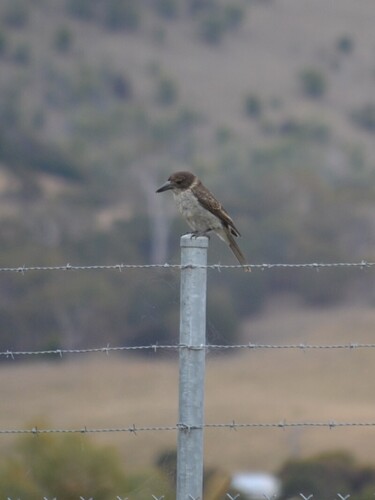
Grey Butcherbird
Cracticus torquatus
The grey butcherbird is a small grey, black and white bird with a weight of 90 grams (3.2 ounces), a body length between 27 and 30 cm (11 and 12 in) and a wing span expanding 37–43 cm (15–17 in). The grey butcherbird is smaller than the Pied Butcherbird (Cracticus nigrogularis). The adult grey butcherbird has a black head, top and sides; and a white chin and throat through to the lower hindneck. The upperbody is mostly dark grey with streaks of narrow white bands that extends across the uppertail-coverts at the base of the tail. The uppertail is black with narrow white tips. Voice: All members of the territorial group contribute to the territorial song, a loud and rollicking song with both musical and harsh elements. The song can be sung by only one member, but more often it is sung in duet or as a group. Some duets are antiphonal where it is not obvious that two or more birds are singing. Most songs are sung with more than one phase and are sung antiphonally.
ID text from Wikipedia, CC BY-SA 4.0

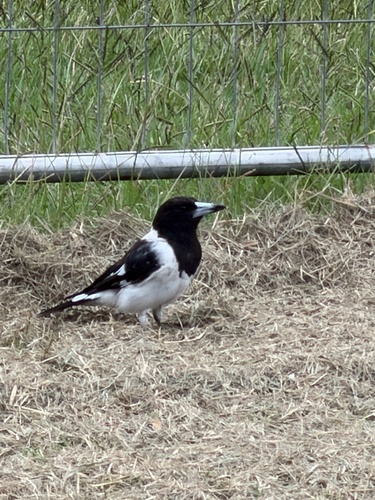
Pied Butcherbird
Cracticus nigrogularis
Like other butcherbirds, the pied butcherbird is stockily built with short legs and a relatively large head. It ranges from 28 to 32 cm (11 to 12.5 in) long, averaging around 31 cm (12 in), with a 51 cm (20 in) wingspan and a weight of around 120 g (4 oz). The wings are fairly long, extending to halfway along the tail when folded. Its plumage is almost wholly black and white, with very little difference between the sexes. It has a black head, nape, and throat, giving it the appearance of a black hood, which is bounded by a white neck collar, which is around 3.2 cm (1.2 in) wide. Voice: The pied butcherbird has been considered the most accomplished songbird in Australia, its song described as a "magic flute" by one writer, richer and clearer than the Australian magpie. Song melodies vary across the continent, and no single song is sung by the whole population. There is no clear demarcation between simple calls and elaborate songs: duets and even larger choirs are common.
ID text from Wikipedia, CC BY-SA 4.0

Where you might meet both
Learn this pair in the BeakBrain App
Photo and call practice. Coming soon to iPhone and Android.
Play today's Daily BirdPhotos and recordings are credited to their authors under the licence shown. Full profiles: Grey Butcherbird and Pied Butcherbird.