Learn what every symbol on the card means.Full credits and sources at beakbrain.com/symbols
 RockyCavity nestSmall · 42 g


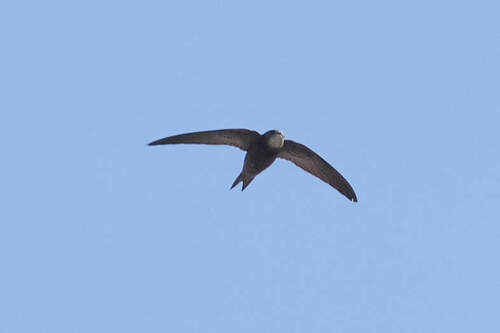
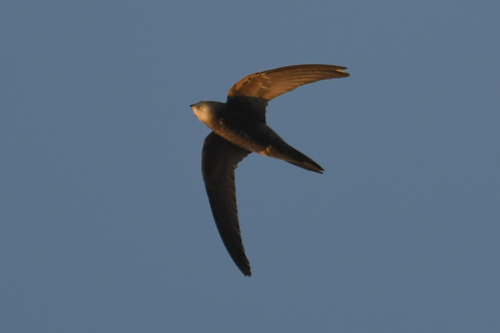
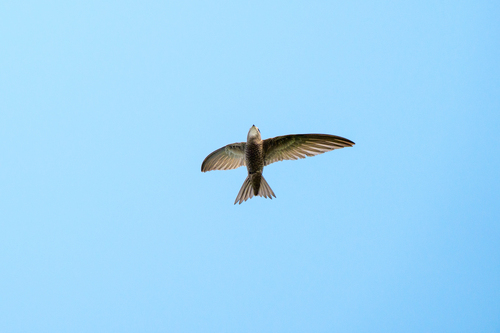

ID tip
This 16–17 cm (6.3–6.7 in) long species is very similar to the common swift, and separation is only possible with good views. Like its relative, it has a short forked tail and very long swept-back wings that resemble a crescent or a boomerang. It is entirely dark except for a large white throat patch which is frequently visible from a distance. It is chunkier and browner than common swift, and the slightly paler flight feathers, underparts and rump give more contrast than that species. It also has a scalier looking belly and subtly different flight action.
Text from Wikipedia, licensed CC BY-SA 4.0.
When to see the Pallid Swift
One bar for each month. Filled bars are the 8 months with records; pale bars are months with none. The wide bar is April, the month with the most records.
Where to see the Pallid Swift
The map shades 54 countries with regular records, and 10 more in a lighter tone where the bird turns up only as a stray. Everything unshaded has no records. Countries are listed below the map.
Recorded as a rare visitor in Belgium, Norway, Netherlands, Germany, Finland, Poland, South Africa, Slovenia, Ireland, San Marino.
About the Pallid Swift
The pallid swift is a swift. Swifts have very short legs which they use only for clinging to vertical surfaces. The genus name Apus is Latin for a swift, thought by the ancients to be a type of swallow with no feet, and pallidus is Latin for "pale". Like other swifts they never settle voluntarily on the ground, but spend most of their lives in the air, living on the insects they catch in their beaks. They drink on the wing.
Text adapted from Wikipedia, licensed CC BY-SA 4.0.
Easily confused with
 White-rumped SwiftApus cafferThis 14–15.5 cm (5.5–6.1 in) long species has, like some relatives, a short forked tail and long swept-back wings that resemble a crescent or a boomerang.
 House SwiftApus nipalensisThe house swift looks quite similar to the little swift.
 Fork-tailed SwiftApus pacificusAt 17–18 cm (6.7–7.1 in) in length, the Pacific swift is the largest of the Apus swifts.
Side by side: Little Swift vs Pallid Swift · House Swift vs Pallid Swift · Pallid Swift vs White-rumped Swift · Fork-tailed Swift vs Pallid Swift
Learn the Pallid Swift in the BeakBrain App
Photo and call practice. Coming soon to iPhone and Android.
Play today's Daily BirdEvery photo and recording on this page is credited to its author under the licence shown. Spotted a problem with this page, or have a better photo? Contribute.