Learn what every symbol on the card means.Full credits and sources at beakbrain.com/symbols
 UrbanCup nestSmall · 30 g


ID tip
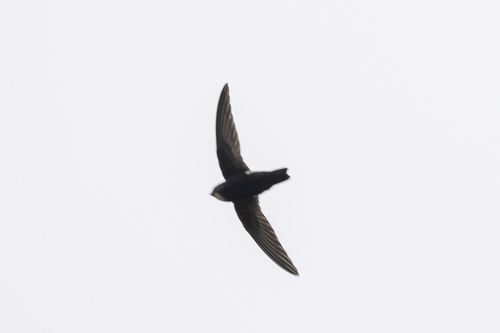
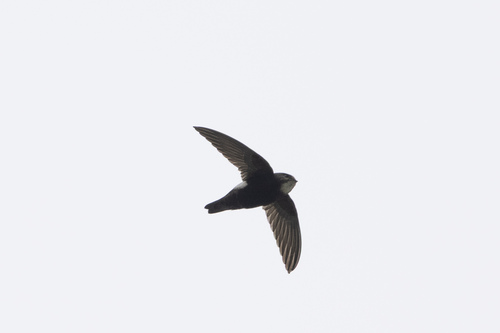
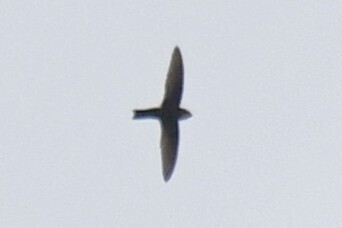
The house swift looks quite similar to the little swift. It is a small bird, but a medium-sized swift, with a wingspan of 12.5-14.5 cm. Its body size ranges from 14 to 16 cm and weighs approximately 20-35 g. This species has a dark, slightly forked tail. Other than the white rump band and white throat-patch, the house swift has a black plumage, darker than the little swift. Voice: House swifts make a ti-ti-ti-tititrrrrrr sound, among many others, as part of their vocal catalogues.
Text from Wikipedia, licensed CC BY-SA 4.0.
When to see the House Swift
One bar for each month, and every month is filled: this bird is recorded here in all twelve. The wide bar is April, the month with the most records.
Where to see the House Swift
The map shades 21 countries with regular records, and 1 more in a lighter tone where the bird turns up only as a stray. Everything unshaded has no records. Countries are listed below the map.
Recorded as a rare visitor in Australia.
About the House Swift
The house swift is a species of swift in the family Apodidae. It is found in Japan, Nepal, and Southeast Asia. It is capable of flying long distances by alternately shutting off hemispheres of its brain in-flight.
Text adapted from Wikipedia, licensed CC BY-SA 4.0.
Easily confused with
 White-rumped SwiftApus cafferThis 14–15.5 cm (5.5–6.1 in) long species has, like some relatives, a short forked tail and long swept-back wings that resemble a crescent or a boomerang.
 Pallid SwiftApus pallidusThis 16–17 cm (6.3–6.7 in) long species is very similar to the common swift, and separation is only possible with good views.
 Fork-tailed SwiftApus pacificusAt 17–18 cm (6.7–7.1 in) in length, the Pacific swift is the largest of the Apus swifts.
Side by side: Common Swift vs House Swift · House Swift vs Little Swift · House Swift vs White-rumped Swift · House Swift vs Pallid Swift · Fork-tailed Swift vs House Swift
Learn the House Swift in the BeakBrain App
Photo and call practice. Coming soon to iPhone and Android.
Play today's Daily BirdEvery photo and recording on this page is credited to its author under the licence shown. Spotted a problem with this page, or have a better photo? Contribute.