Learn what every symbol on the card means.Full credits and sources at beakbrain.com/symbols
 WoodlandCup nestSmall · 39 g


ID tip
At 17–18 cm (6.7–7.1 in) in length, the Pacific swift is the largest of the Apus swifts. It has a 43-to-54-cm (17-to-21-in) wingspan. Females are slightly heavier than males, averaging 44.5 g (1.57 oz) against 42.5 g (1.50 oz). It is similar in general shape to the common swift, although slightly longer-winged and with a more protruding head. The fork of the tail is deeper, and the rump is broader. The upperparts are black, apart from a white rump band and a somewhat greyer head. Voice: The calls given by flocks near the breeding areas are typical swift screams, including a trilled tsiririri or harsher spee-eer. They resemble the cries of the common swift, but are softer and less wheezy. Pacific swifts are less vocal on the wintering grounds, but produce a variety of twitters and buzzes.
Text from Wikipedia, licensed CC BY-SA 4.0.
When to see the Fork-tailed Swift
One bar for each month, and every month is filled: this bird is recorded here in all twelve. The wide bar is April, the month with the most records.
Where to see the Fork-tailed Swift
The map shades 28 countries with regular records, and 9 more in a lighter tone where the bird turns up only as a stray. Everything unshaded has no records. Countries are listed below the map.
Recorded as a rare visitor in Sweden, United Kingdom, India, United States, New Zealand, Oman, Denmark, Italy, Guam.
About the Fork-tailed Swift
The Pacific swift is a species of bird that is part of the Swift family. It breeds in eastern Asia. It is strongly migratory, spending the northern hemisphere's winter in Southeast Asia and Australia. The general shape and blackish plumage recall its relative, the common swift, from which it is distinguished by a white rump band and heavily marked underparts. The sexes are identical in appearance, although young birds can be identified by pale fringes to the wing feathers that are absent in adults. This swift's main call is a screech typical of its family. It is one of a group of closely related Asian swifts formerly regarded as one species.
Text adapted from Wikipedia, licensed CC BY-SA 4.0.
Easily confused with
 African Black SwiftApus barbatusThe African black swift is 16–18 cm (6.3–7.1 in) long and bulky like a pallid swift; it appears entirely blackish-brown except for a small white or pale grey patch on the chin which is not visible from a distance.
 Plain SwiftApus unicolorThe plain swift is a medium-sized swift.
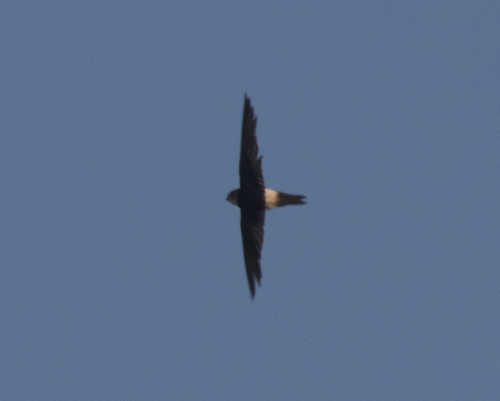 Horus SwiftApus horusThe Horus swift is 13–15 cm (5.1–5.9 in) long and quite bulky.
Side by side: Fork-tailed Swift vs House Swift · Fork-tailed Swift vs White-rumped Swift · Fork-tailed Swift vs Pallid Swift · African Black Swift vs Fork-tailed Swift · Fork-tailed Swift vs Horus Swift
Learn the Fork-tailed Swift in the BeakBrain App
Photo and call practice. Coming soon to iPhone and Android.
Play today's Daily BirdEvery photo and recording on this page is credited to its author under the licence shown. Spotted a problem with this page, or have a better photo? Contribute.