Learn what every symbol on the card means.Full credits and sources at beakbrain.com/symbols
 ShrublandCavity nestSmall · 27 g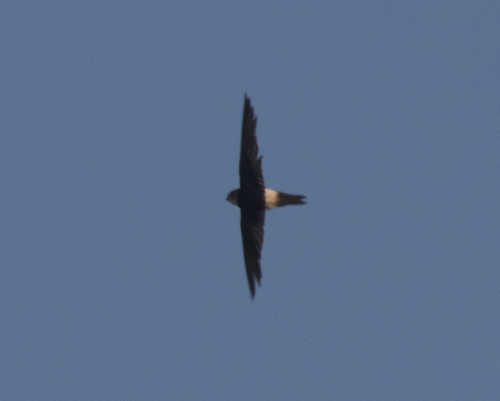


ID tip
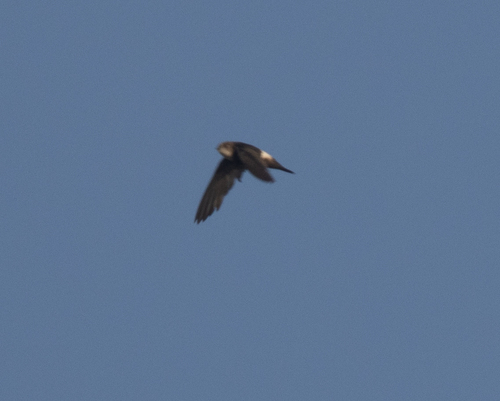
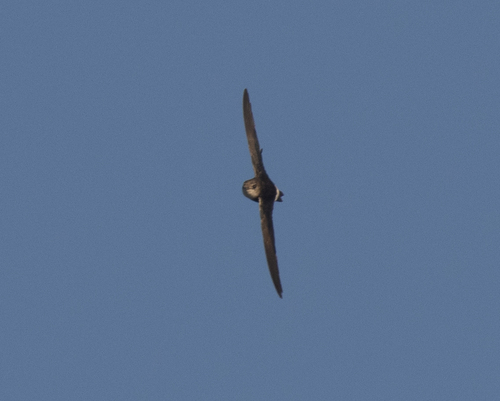
The Horus swift is 13–15 cm (5.1–5.9 in) long and quite bulky. It appears entirely blackish except for a white patch on the chin and a white rump. It has a medium length forked tail. It has a fluttering flight like little swift. The little swift has a square tail, and more extensive white on the rump than Horus, and white-rumped swift has a more deeply forked tail and a narrower white band. The call is a buzzing peeeeooo, peeeeooo.
Text from Wikipedia, licensed CC BY-SA 4.0.
When to see the Horus Swift
One bar for each month. Filled bars are the 9 months with records; pale bars are months with none. The wide bar is November, the month with the most records.
Where to see the Horus Swift
The map shades 21 countries with regular records, and 1 more in a lighter tone where the bird turns up only as a stray. Everything unshaded has no records. Countries are listed below the map.
Recorded as a rare visitor in Sudan.
About the Horus Swift
The Horus swift is a small bird in the swift family Apodidae that is found in sub-Saharan Africa. Horus, whose name this bird commemorates, was the ancient Egyptian god of the sun, son of Osiris and Isis.
Text adapted from Wikipedia, licensed CC BY-SA 4.0.
Easily confused with
 Plain SwiftApus unicolorThe plain swift is a medium-sized swift.
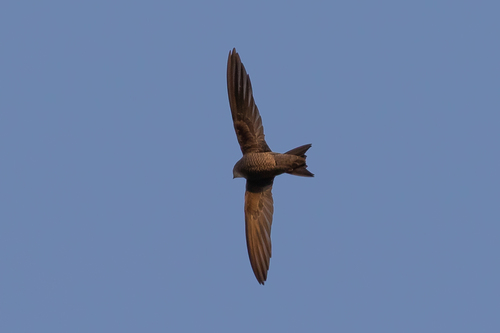 Bradfield's SwiftApus bradfieldiBradfield's swift is a species of swift in the family Apodidae.
 Nyanza SwiftApus niansaeThe Nyanza swift, also known as the brown swift, is a medium sized bird with sleek wings, along with a small and compact head.
Side by side: Fork-tailed Swift vs Horus Swift · African Black Swift vs Horus Swift · Horus Swift vs Nyanza Swift
Learn the Horus Swift in the BeakBrain App
Photo and call practice. Coming soon to iPhone and Android.
Play today's Daily BirdEvery photo and recording on this page is credited to its author under the licence shown. Spotted a problem with this page, or have a better photo? Contribute.