Learn what every symbol on the card means.Full credits and sources at beakbrain.com/symbols
 GrasslandCup nestSmall · 21 g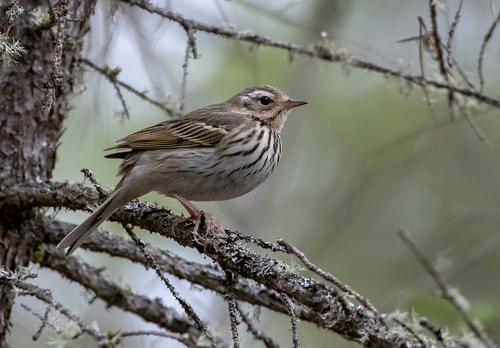


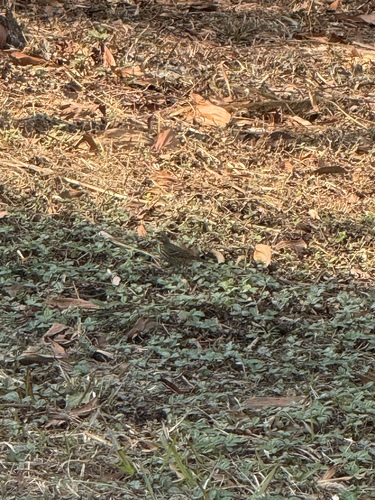
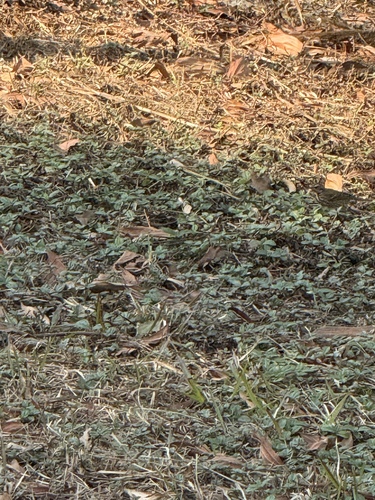
What the Olive-backed Pipit sounds like


ID tip
Size: Sparrow+ (ca. 15 cm (5.9 in)) Appearance: Greenish brown streaked with darker brown above. Supercilium, double wingbar and outer rectrices whitish. Whitish to buff below streaked with dark brown on breast and flanks. Sexes alike. Habits: Seen singly or pairs. Runs about on the ground in search of food and flies up into trees when disturbed. Flight jerky and undulating. Call: Song lark-like and uttered on the wing, similar to the tree pipit, but faster and higher pitched. A single tseep or spek, also similar to the tree pipit. Food: Insects, grass and weed seeds.
Text from Wikipedia, licensed CC BY-SA 4.0.
When to see the Olive-backed Pipit
One bar for each month. Filled bars are the 8 months with records; pale bars are months with none. The wide bar is April, the month with the most records.
Where to see the Olive-backed Pipit
The map shades 39 countries with regular records, and 11 more in a lighter tone where the bird turns up only as a stray. Everything unshaded has no records. Countries are listed below the map.
Recorded as a rare visitor in United States, France, Finland, Netherlands, Morocco, Ireland, Iceland, Switzerland, Azerbaijan, Kazakhstan, Palestinian Territories.
About the Olive-backed Pipit
The olive-backed pipit is a small passerine bird of the pipit (Anthus) genus, which breeds across southern, north central and eastern Asia, as well as in the north-eastern European Russia. It is a long-distance migrant moving in winter to southern Asia and Indonesia. Sometimes it is also called Indian pipit or Hodgson's pipit, as well as tree pipit owing to its resemblance with the tree pipit. However, its back is more olive-toned and less streaked than that species, and its head pattern is different with a better-marked supercilium.
Text adapted from Wikipedia, licensed CC BY-SA 4.0.
Easily confused with
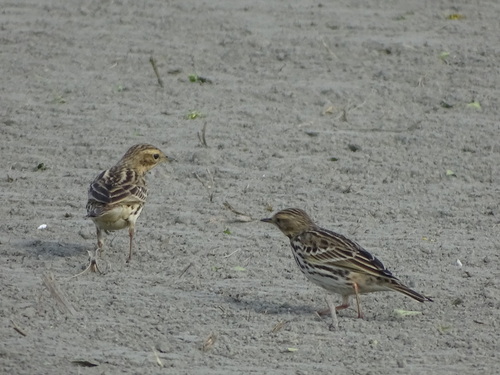 Red-throated PipitAnthus cervinusThis is a small pipit, with an adult easily identified in the breeding season by its brick-red face and throat.
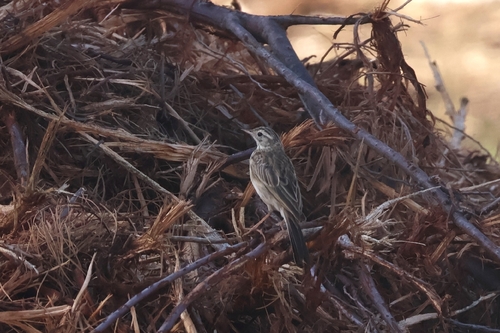 Australian PipitAnthus australisIt is a slender bird, 16 to 19 cm long, and weighs about 40 grams.
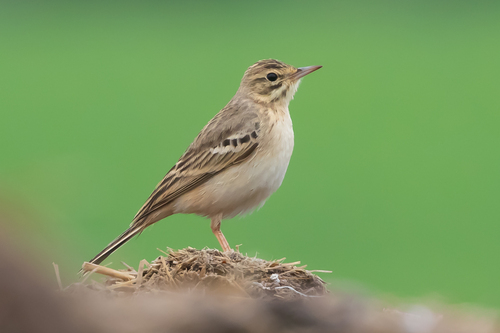 Tawny PipitAnthus campestrisThis is a large pipit, 16 centimetres (6.3 in) long with wing-span 25–28 centimetres (9.8–11.0 in), but is an undistinguished looking species on the ground, mainly sandy brown above and pale below.
Side by side: Olive-backed Pipit vs Tawny Pipit · Olive-backed Pipit vs Red-throated Pipit · Australian Pipit vs Olive-backed Pipit
Learn the Olive-backed Pipit in the BeakBrain App
Photo and call practice. Coming soon to iPhone and Android.
Play today's Daily BirdEvery photo and recording on this page is credited to its author under the licence shown. Spotted a problem with this page, or have a better photo? Contribute.