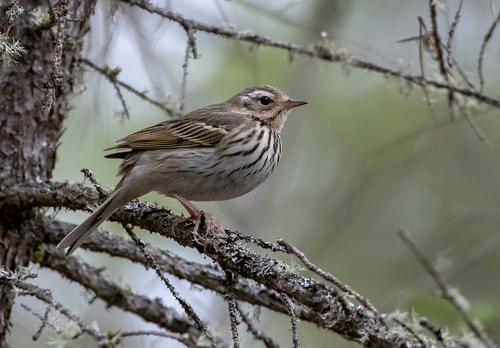
Olive-backed Pipit
Anthus hodgsoni
Size: Sparrow+ (ca. 15 cm (5.9 in)) Appearance: Greenish brown streaked with darker brown above. Supercilium, double wingbar and outer rectrices whitish. Whitish to buff below streaked with dark brown on breast and flanks. Sexes alike. Habits: Seen singly or pairs. Runs about on the ground in search of food and flies up into trees when disturbed. Flight jerky and undulating. Call: Song lark-like and uttered on the wing, similar to the tree pipit, but faster and higher pitched. A single tseep or spek, also similar to the tree pipit. Food: Insects, grass and weed seeds.
ID text from Wikipedia, CC BY-SA 4.0

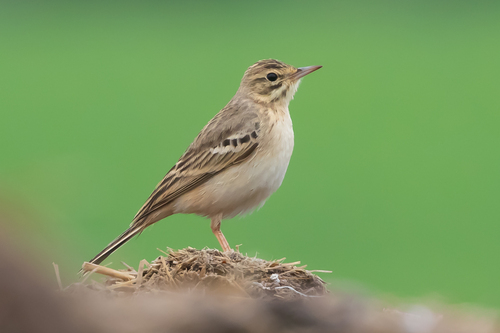
Tawny Pipit
Anthus campestris
This is a large pipit, 16 centimetres (6.3 in) long with wing-span 25–28 centimetres (9.8–11.0 in), but is an undistinguished looking species on the ground, mainly sandy brown above and pale below. It is very similar to Richard's pipit, but is slightly smaller, has shorter wings, tail and legs and a narrower dark bill. It is also less streaked. Its flight is strong and direct, and it gives a characteristic "schip" call, higher pitched than Richard's. Its song is a short repetition of a loud disyllabic chir-ree chir-ree.
ID text from Wikipedia, CC BY-SA 4.0

Where you might meet both
Learn this pair in the BeakBrain App
Photo and call practice. Coming soon to iPhone and Android.
Play today's Daily BirdPhotos and recordings are credited to their authors under the licence shown. Full profiles: Olive-backed Pipit and Tawny Pipit.