Learn what every symbol on the card means.Full credits and sources at beakbrain.com/symbols
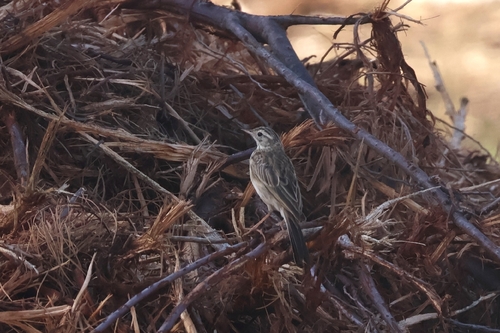
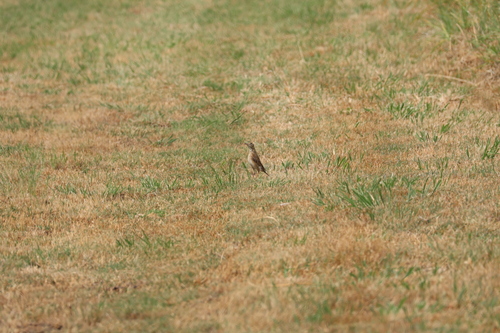
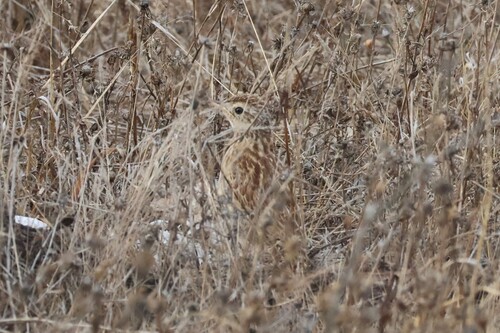


ID tip
It is a slender bird, 16 to 19 cm long, and weighs about 40 grams. The plumage is pale brown above with dark streaks. The underparts are pale with streaks on the breast. There is a pale stripe over the eye and dark malar and moustachial stripes. The long tail has white outer-feathers and is often wagged up and down. The legs are long and pinkish-brown while the bill is slender and brownish. It has a sparrow-like chirruping call and a drawn-out tswee call.
Text from Wikipedia, licensed CC BY-SA 4.0.
When to see the Australian Pipit
One bar for each month, and every month is filled: this bird is recorded here in all twelve. The wide bar is October, the month with the most records.
Where to see the Australian Pipit
The map shades 2 countries with regular records. Everything unshaded has no records. Countries are listed below the map.
About the Australian Pipit
The Australian pipit is a fairly small passerine bird of open country in Australia and New Guinea. It belongs to the pipit genus Anthus in the family Motacillidae.
Text adapted from Wikipedia, licensed CC BY-SA 4.0.
Easily confused with
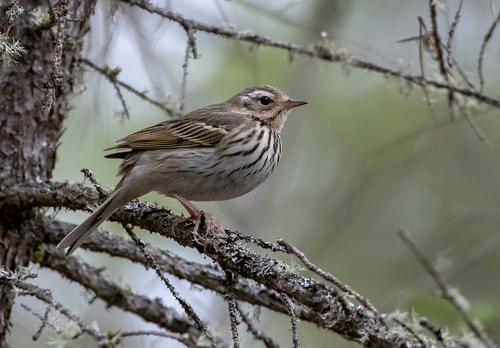 Olive-backed PipitAnthus hodgsoniSize: Sparrow+ (ca. 15 cm (5.9 in))
Appearance: Greenish brown streaked with darker brown above.
Olive-backed PipitAnthus hodgsoniSize: Sparrow+ (ca. 15 cm (5.9 in))
Appearance: Greenish brown streaked with darker brown above.
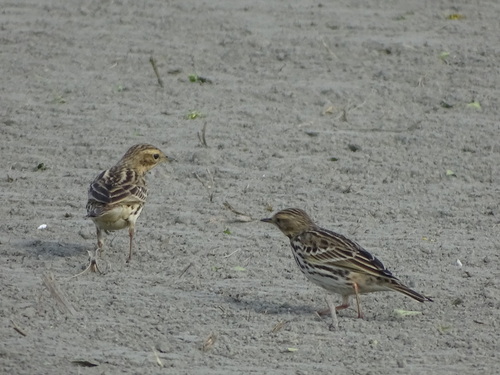 Red-throated PipitAnthus cervinusThis is a small pipit, with an adult easily identified in the breeding season by its brick-red face and throat.
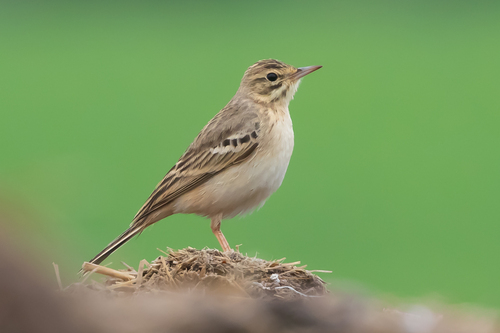 Tawny PipitAnthus campestrisThis is a large pipit, 16 centimetres (6.3 in) long with wing-span 25–28 centimetres (9.8–11.0 in), but is an undistinguished looking species on the ground, mainly sandy brown above and pale below.
Side by side: Australian Pipit vs Tawny Pipit · Australian Pipit vs Red-throated Pipit · Australian Pipit vs Olive-backed Pipit · Australian Pipit vs New Zealand Pipit
Learn the Australian Pipit in the BeakBrain App
Photo and call practice. Coming soon to iPhone and Android.
Play today's Daily BirdEvery photo and recording on this page is credited to its author under the licence shown. Spotted a problem with this page, or have a better photo? Contribute.