Learn what every symbol on the card means.Full credits and sources at beakbrain.com/symbols
 GrasslandDomed nestSmall · 16 g


ID tip
This short-tailed bishop is small in size, about 11 cm and weighing about 12-22 grams. The striking red-orange feathers are produced by pigments derived from compounds in their diet. Specifically, the yellow, orange, and red pigments originate from compounds called carotenoids, which are very diet-dependent. Lutein and two red fractions (R1 and R2) derived from lutein are the two dominating carotenoids that contribute to the bird's pigment in the wild. Northern red bishops held in captivity lack the R2 red fraction carotenoid from their diet.
Text from Wikipedia, licensed CC BY-SA 4.0.
When to see the Northern Red Bishop
One bar for each month. Filled bars are the 10 months with records; pale bars are months with none. The wide bar is September, the month with the most records.
Where to see the Northern Red Bishop
The map shades 35 countries with regular records, and 2 more in a lighter tone where the bird turns up only as a stray. Everything unshaded has no records. Countries are listed below the map.
Recorded as a rare visitor in Spain, United Arab Emirates.
About the Northern Red Bishop
The northern red bishop or orange bishop is a small passerine bird in the family Ploceidae. It is part of the largest genus in the family with over 60 different species. Its sister species is the Southern red bishop. This species is most recognizable by the bright reddish orange with contrasting black plumage displayed by the breeding male. It is most common throughout the northern African continent but has also been introduced to areas in the western hemisphere.
Text adapted from Wikipedia, licensed CC BY-SA 4.0.
Easily confused with
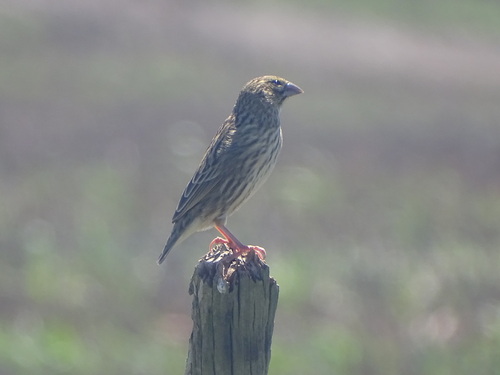 Yellow BishopEuplectes capensisThe yellow bishop is a stocky 15 centimetres (5.9 in) long bird.
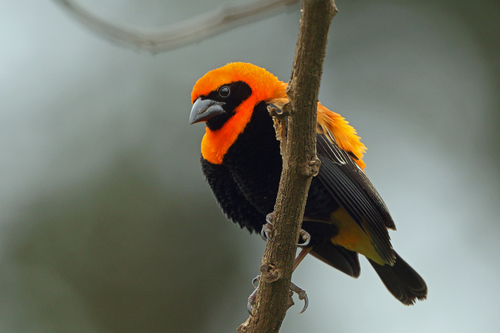 Black-winged Red BishopEuplectes hordeaceusThe black-winged red bishop is a stocky 13–15 cm (5.1–5.9 in) bird.
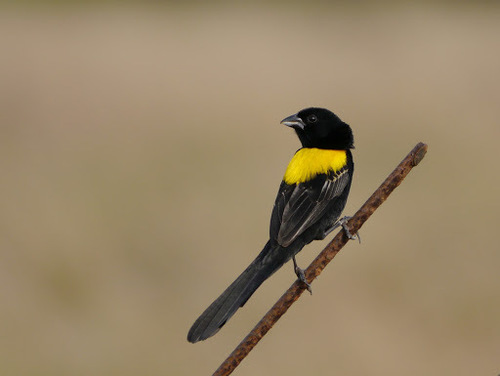 Yellow-mantled WidowbirdEuplectes macrouraMales are larger than females and acquire longer tails and striking black and golden yellow plumages in the breeding season.
Side by side: Northern Red Bishop vs Yellow Bishop · Northern Red Bishop vs Sociable Weaver · Black-winged Red Bishop vs Northern Red Bishop · Northern Red Bishop vs Yellow-mantled Widowbird
Learn the Northern Red Bishop in the BeakBrain App
Photo and call practice. Coming soon to iPhone and Android.
Play today's Daily BirdEvery photo and recording on this page is credited to its author under the licence shown. Spotted a problem with this page, or have a better photo? Contribute.