
Northern Red Bishop
Euplectes franciscanus
This short-tailed bishop is small in size, about 11 cm and weighing about 12-22 grams. The striking red-orange feathers are produced by pigments derived from compounds in their diet. Specifically, the yellow, orange, and red pigments originate from compounds called carotenoids, which are very diet-dependent. Lutein and two red fractions (R1 and R2) derived from lutein are the two dominating carotenoids that contribute to the bird's pigment in the wild. Northern red bishops held in captivity lack the R2 red fraction carotenoid from their diet.
ID text from Wikipedia, CC BY-SA 4.0
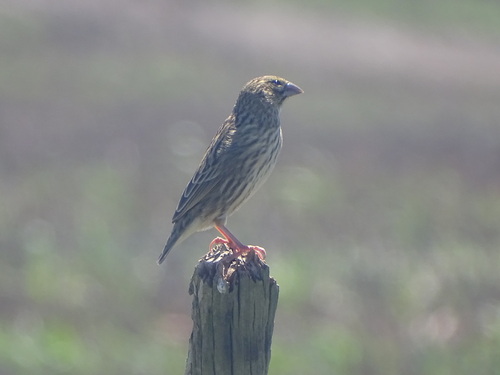
Yellow Bishop
Euplectes capensis
The yellow bishop is a stocky 15 centimetres (5.9 in) long bird. The breeding male is black apart from his bright yellow lower back, rump, and shoulder patches, and brown edging to the wing feathers. He has a short crest, thick conical black bill, and a relatively short tail. His bill size varies dramatically between races. In non-breeding plumage, the black plumage is replaced by heavily streaked buffy-brown, and the bill is pale. The yellow shoulders and rump remain, and are a distinction from the female which lacks the contrasting colour patches. Voice: Calls include zeet zeet zeet, and a harsh zzzzzzt given by the male in flight. The song of the isolated SW Cameroon phoenicomerus is quite different: a dry rattle followed by swit-err, swit-err.
ID text from Wikipedia, CC BY-SA 4.0

Where you might meet both
Learn this pair in the BeakBrain App
Photo and call practice. Coming soon to iPhone and Android.
Play today's Daily BirdPhotos and recordings are credited to their authors under the licence shown. Full profiles: Northern Red Bishop and Yellow Bishop.