Learn what every symbol on the card means.Full credits and sources at beakbrain.com/symbols
 WetlandCavity nestHuge · 2.4 kg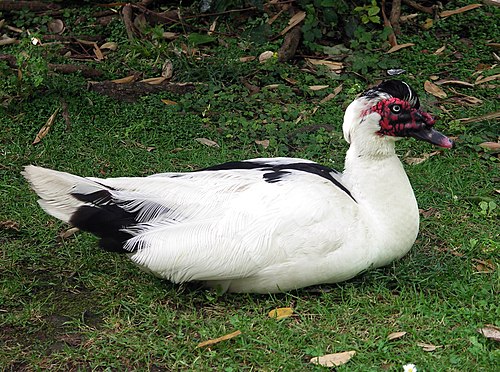


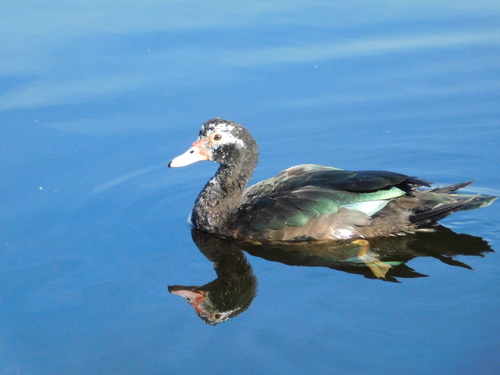
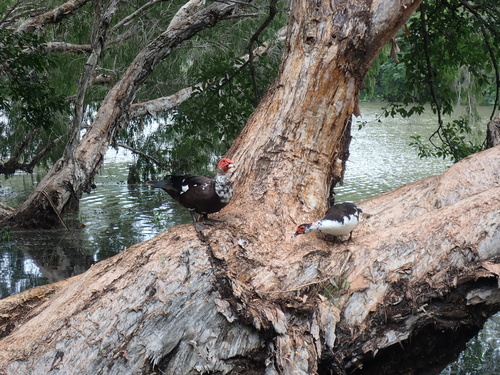
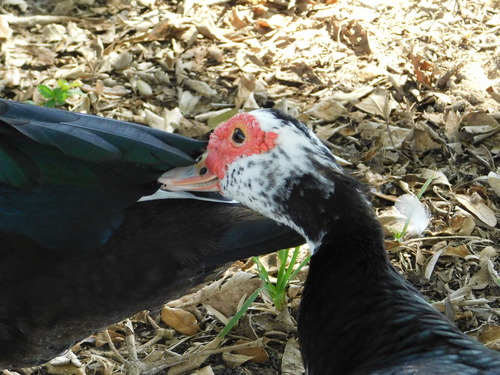

ID tip
It is a large duck, with the males significantly larger than the females. The males are 76–84 cm (30–33 in) long and weigh up to 3–4 kg (6.6–8.8 lb); females are 71–76 cm (28–30 in) long and 1.25 kg (2.8 lb) weight, roughly half the weight of the males. The wingspan is from 137 to 152 cm (54 to 60 in). The plumage is predominantly black, with large white patches on the wing; the back and wing feathers being iridescent and glossy in males, while the females are more drab. Muscovy ducks have long claws on their feet and a wide, flat tail. On the head, the male has a short crest on the nape.
Text from Wikipedia, licensed CC BY-SA 4.0.
When to see the Muscovy Duck
One bar for each month, and every month is filled: this bird is recorded here in all twelve. The wide bar is January, the month with the most records.
Where to see the Muscovy Duck
The map shades 112 countries with regular records, and 17 more in a lighter tone where the bird turns up only as a stray. Everything unshaded has no records. Countries are listed below the map.
Recorded as a rare visitor in Luxembourg, Morocco, Nepal, Botswana, Namibia, Tunisia, Zimbabwe, St. Kitts & Nevis, Iran, Tajikistan, Guam, Mayotte, São Tomé & Príncipe, Zambia, Sweden, Cook Islands, Wallis & Futuna.
About the Muscovy Duck
The Muscovy duck is a species of duck native to the Americas, from the Lower Rio Grande Valley of Texas and Mexico south to Argentina and Uruguay. The species has been domesticated, and feral Muscovy ducks can be found locally in New Zealand, Australia, the United States, and in Central and Eastern Europe.
Text adapted from Wikipedia, licensed CC BY-SA 4.0.
Easily confused with
 Black SwanCygnus atratusBlack swans are black-feathered birds, with white flight feathers.
 Mottled DuckAnas fulvigulaThe adult mottled duck is 44 to 61 cm (17–24 in) long from head to tail.
 Black ScoterMelanitta americanaThis large sea duck is characterised by its bulky shape and large bill.
Side by side: Maned Duck vs Muscovy Duck · Black Swan vs Muscovy Duck · Mottled Duck vs Muscovy Duck · Black Scoter vs Muscovy Duck
Learn the Muscovy Duck in the BeakBrain App
Photo and call practice. Coming soon to iPhone and Android.
Play today's Daily BirdEvery photo and recording on this page is credited to its author under the licence shown. Spotted a problem with this page, or have a better photo? Contribute.