
Maned Duck
Chenonetta jubata
This 45–51 cm (18–20 in) duck looks like a small goose, and mostly feeds by grazing in flocks. The male is grey with a dark brown head, mottled breast and very thin white and black stripes on sides/flanks. The female has white stripes above and below the eye and mottled underparts. Both sexes have grey wings with black primaries and a white speculum. Juveniles are similar to adult females, but lighter and with a more streaky breast. The Australian wood duck can be distinguished from pygmy geese, Nettapus spp., which are smaller, have bold white face markings and are usually seen on water. Voice: The most common call is a loud, rising croaky gnow sound by the females, and the male call is the same except smoother, shorter and higher than the females. Staccato chattering is also present in flocks.
ID text from Wikipedia, CC BY-SA 4.0
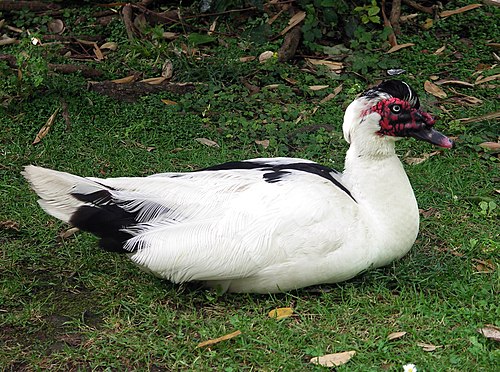
Muscovy Duck
Cairina moschata
It is a large duck, with the males significantly larger than the females. The males are 76–84 cm (30–33 in) long and weigh up to 3–4 kg (6.6–8.8 lb); females are 71–76 cm (28–30 in) long and 1.25 kg (2.8 lb) weight, roughly half the weight of the males. The wingspan is from 137 to 152 cm (54 to 60 in). The plumage is predominantly black, with large white patches on the wing; the back and wing feathers being iridescent and glossy in males, while the females are more drab. Muscovy ducks have long claws on their feet and a wide, flat tail. On the head, the male has a short crest on the nape.
ID text from Wikipedia, CC BY-SA 4.0
Where you might meet both
Learn this pair in the BeakBrain App
Photo and call practice. Coming soon to iPhone and Android.
Play today's Daily BirdPhotos and recordings are credited to their authors under the licence shown. Full profiles: Maned Duck and Muscovy Duck.